

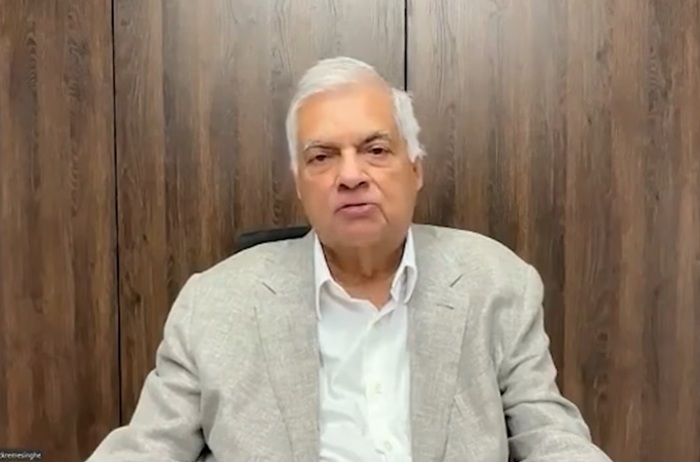
Former President Ranil Wickremesinghe has warned that Sri Lanka must undergo rapid economic and technological transformation to remain relevant in the emerging global order, cautioning that failure to adapt could leave the country increasingly insignificant on the international stage.
Addressing the 50th webinar of ICC Sri Lanka on Monday (26), Wickremesinghe said Sri Lanka must develop a strong, competitive economy through technology-oriented modernisation while positioning itself as a maritime logistics hub in the Indian Ocean.
“We in Sri Lanka must adapt to these changes, or we will be swallowed up by bigger fish. We need economic and social transformation based on technology-oriented modernisation,” he said.
The former President outlined several priorities for Sri Lanka, including closer economic cooperation with India, stronger relations with Bay of Bengal countries and Southeast Asia, and eventual regional economic integration.
He also called for Sri Lanka to join BRICS, strengthen relations with the United States, China, Russia and Japan, and adopt a more transactional approach to international relations.
Wickremesinghe further proposed reviewing the effectiveness of the Indian Ocean Rim Association (IORA) and BIMSTEC, accelerating the Colombo Security Conclave and developing a technologically advanced navy equipped with small and medium-sized vessels.
Highlighting the strategic importance of the Indian Ocean, he said Sri Lanka must safeguard its economic interests, particularly the continued operation of the Suez Canal and the Gulf, which he described as the country’s two economic lifelines.
Referring to the growing influence of artificial intelligence and emerging technologies, Wickremesinghe said technological capabilities were increasingly becoming a defining factor of national sovereignty and global power.
He noted that the United States and China were emerging as dominant powers in artificial intelligence and computing, while other countries, including India, Japan and several European nations, were advancing their technological capabilities.
The former President also highlighted the economic potential of the Bay of Bengal and the importance of protecting undersea communication cables and strengthening maritime security.
Warning against inaction, Wickremesinghe said Sri Lanka could not afford to remain outside the changing geopolitical landscape.
“Either we go this way, or we fade into insignificance, like one of the small Pacific islands,” he cautioned.
Full statement :
It is my privilege to be here at the 50th webinar of ICC Sri Lanka.
Addressing the NDTV World Summit, Prime Minister Narendra Modi described the present as a world between orders: the ending of one and the start of another. It is worth watching on YouTube. He highlighted the weaponisation of finance, trade, technology and shipping as part of today’s new geopolitics. The post-World War II institutions are unable to intervene because they have not adapted to the changing world order. The Prime Minister quoted Chanakya on the need to prevent Matsya Nyaya, the law of the fishes, where the strong swallow the weak.
The existing global order, which had its roots in 19th-century Europe, is being replaced by a new 21st-century order. That order is shaped by newly emerging forces, and by the newest of them all: technological advancement.
The Goldman Sachs report on the Generative World Order states that AI and data ownership, combined with dollar-dominated global financial markets, form the basis of U.S. dominance. China, the other AI superpower, is working with BRICS members to find an alternative through de-dollarisation. What we are witnessing today is a duopoly of AI and computing superpowers. China and America have also taken the lead in other technologies such as space, ocean and automation. There are also powers such as India, the UK, France, Germany, Israel, Japan and South Korea developing their own technology. So we have to remember that sovereignty today implies technology.
Where are we in Sri Lanka? Institut Montaigne calls this the end of the nation state. I think it is more a transformation. We are witnessing the decline of the geopolitics of Western-led alliances and the beginning of transactional geopolitics between the leading powers. According to the Oxford Institute for New Thinking, global governance will increasingly depend on pivotal power coalitions operating within a broader polycentric system.
We in Sri Lanka must adapt to these changes, or we will be swallowed up by bigger fish. We need economic and social transformation based on technology-oriented modernisation. I will say that again: we need economic and social transformation based on technology-oriented modernisation.
The Indian Ocean
The Indian Ocean will be one of the centres of the new global order, together with the emerging economic powers of Asia and Africa. It will strengthen its position as the main shipping artery connecting East and West, and its undersea resources are immense and available for exploration.
With the U.S.–Iran war, we are also witnessing the decline of the Indian Ocean as a zone of peace, of its freedom of navigation, and of U.S. power in West Asia. New power centres are emerging. In West Asia, Iran dominates on one side. On the other is the Mecca Pact of Saudi Arabia, Pakistan, Egypt and Turkey. Israel remains another player. Sri Lanka’s interest is in ensuring that its two economic lifelines, the Suez Canal and the Gulf, remain fully operational.
Second, we must not ignore the potential of the Bay of Bengal as an economic region. India, the dominant power in the region, ranks among the top three economies by GDP. Indonesia, expected to have the fourth or fifth largest GDP in the world by 2050, is extending its influence. It recently ordered new submarines from Italy and took over the aircraft carrier Garibaldi. Bangladesh will also emerge as an economic power. Southeast Asian economies and China are moving towards closer economic cooperation through western China. This is producing the Chengdu–Chongqing corridor extending to Myanmar and Bangladesh, which will give China a second point of access to the Indian Ocean, this time in the Bay of Bengal.
Third, we have an economic region at our doorstep: a market of 600 million people, excluding India.
Finally, there is the emergence of new technologies: the space–ocean–telemetry nexus. This includes orbital and maritime awareness satellites, guided hypersonic corridors, unmanned underwater vehicles and drones, which will play a major role in the security of the Indian Ocean. Protecting the undersea cables in our region is also a priority.
This new world order is already taking shape. We will see a trilateral meeting of the U.S., Russia and China in China. Whatever the outcome, these meetings will continue. This year alone, there will be four meetings between the Presidents of the United States and China.
What Sri Lanka must do
We in Sri Lanka must prepare for the new global order. The main requirements are:
- Rapid technological modernisation, resulting in a strong, competitive economy. If we do not do this, we will have no place in the new world order.
- Make Sri Lanka a maritime logistics centre.
- Build closer economic cooperation with India.
- Strengthen relations with the Bay of Bengal countries and Southeast Asia, leading eventually to regional integration.
- Join BRICS.
- Strengthen relations with the three major powers, the U.S., China and Russia, as well as Japan.
- Engage in transactional geopolitics. There is no other way. We cannot sit it out.
- Review the effectiveness of IORA and BIMSTEC. Both organisations need fundamental changes if we are to continue in them.
- Accelerate the work of the Colombo Security Conclave. This will be important for the Indian Ocean now and in the future.
- Build a technologically advanced navy with small and medium-sized ships.
This is what we must do to survive in a new global order where technology plays a central role and trade remains important. Either we go this way, or we fade into insignificance, like one of the small Pacific islands.
Thank you. (Newswire)