

Sri Lankan exporters have been urged to prepare for new European Union packaging requirements that could affect market access for key export sectors, including tea, spices, seafood, processed food and beverages.
The EU’s Packaging and Packaging Waste Regulation (PPWR), which entered into force in February 2025 and generally applies from Aug. 12, 2026, introduces requirements covering recyclability, recycled plastic content, reuse, harmonized labeling, Extended Producer Responsibility (EPR) and traceability.
The requirements apply to packaging placed on the EU market, including products imported from Sri Lanka, and are also expected to affect local packaging manufacturers serving export-oriented industries.
Businesses may need to review packaging designs, materials, sourcing practices, supplier traceability, certification and sustainability reporting to comply with the regulation.
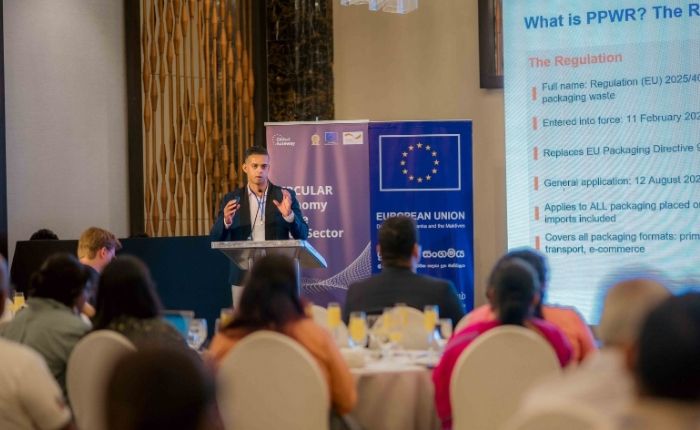
To help Sri Lankan businesses prepare, a two-day seminar was held in Colombo on July 13 and 14 under the EU-funded CIRCULAR – Circular Economy in the Food Sector Project.
More than 100 representatives of Sri Lankan businesses participated in the seminar, which provided guidance on the regulatory and technical requirements of the PPWR and steps companies can take toward compliance.
“As the Packaging and Packaging Waste Regulation begins to apply, early preparation will be essential to help businesses adapt smoothly, preserve access to the EU market, and strengthen their position in an increasingly sustainability-driven global economy,” said Dr. Johann Hesse, head of cooperation at the Delegation of the European Union to Sri Lanka.
The seminar covered five key areas of the regulation — recyclability, recycled content, reuse, harmonized labeling and waste prevention.
Participants were also briefed on regulatory milestones, including restrictions on per- and polyfluoroalkyl substances (PFAS) in food-contact packaging from August 2026 and requirements for tea bags and certain other packaging formats to be industrially compostable from February 2028.
The program also focused on packaging redesign, sustainable material selection, supplier due diligence, certification, traceability and technical documentation.
Mahmoud Gaballah, project manager of the CIRCULAR Project at Expertise France, said sustainable packaging was increasingly becoming a business requirement rather than solely an environmental objective.
“Through the CIRCULAR Project, we are promoting knowledge, innovation and resource efficiency to help Sri Lankan industries prepare for the future while building more sustainable and resilient value chains in the food sector,” he said.
Sri Lanka Institute of Packaging President Nishan Perera said understanding the EU regulations was important for the country’s export-oriented food and packaging industries.
The seminar was organized with EU support through the CIRCULAR Project, jointly implemented by Expertise France, the Food and Agriculture Organization of the United Nations and Deutsche Gesellschaft für Internationale Zusammenarbeit (GIZ) GmbH.
The project supports Sri Lanka’s transition toward a circular economy, with a focus on reducing food loss and waste and addressing single-use plastic pollution. (Newswire)