

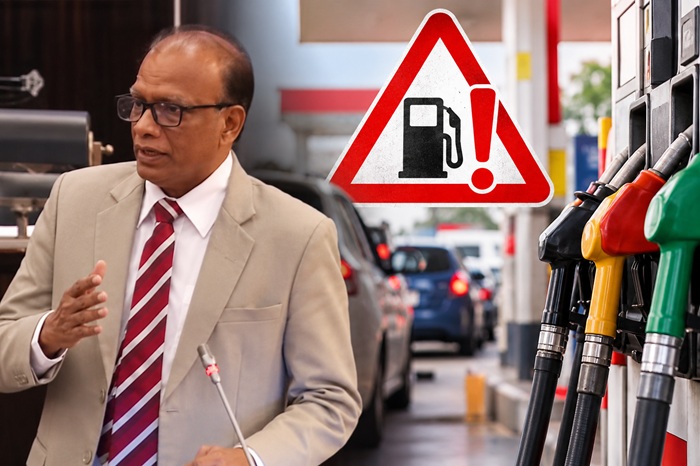
Minister of Energy Anura Karunathilake told Parliament that legal advice will be sought on action that could be taken under the Petroleum Act and powers vested in the Ministry if private fuel supply companies continue to restrict fuel distribution to filling stations.
The Minister said discussions are scheduled to be held at the Presidential Secretariat with fuel operators, and that further action would be considered if the companies fail to reach an agreement and continue imposing restrictions.
Karunathilake said the issue had arisen because private fuel suppliers were incurring losses after the Government decided not to increase domestic fuel prices in line with rising global prices.
He said the companies had requested an increase in local fuel prices to reflect global market prices. However, as the Government was unable to accommodate the requested increase, a three-month concession had been provided to supply diesel at Rs. 70 per litre.
Despite the concession, the companies had indicated that continued losses would force them to restrict fuel supplies to the domestic market, the Minister said.
Karunathilake explained that under agreements signed with the companies, the Government has the authority to issue a general notice requiring them to maintain the minimum fuel supply necessary for the country to function. However, the Ministry does not have the authority to direct individual companies on fuel distribution to particular filling stations.
He said the Ceylon Petroleum Corporation (CPC) had stepped up its fuel distribution to mitigate shortages in the local market. According to the Minister, the CPC initially accounted for around 50% to 55% of the domestic market when the issue emerged, but its share has since increased to around 77% to 80%.
The Ministry has also requested private suppliers to maintain adequate supplies to prevent disruptions in the local market, he added.
Karunathilake said the Government could intervene under existing agreements if companies restricted the volume of fuel imported into the country, but its powers were limited when it came to distribution to individual filling stations.
Referring to four agreements, including the most recent signed in 2022, the Minister said none contained provisions allowing the Government to intervene when a supplier refused to provide fuel to a particular filling station or area.
He further said the agreements allow companies to determine their selling prices based on the fuel pricing formula. However, private suppliers have generally opted to set prices similar to those determined by the CPC.
The Minister made the remarks in response to a question raised by SJB MP S.M. Marikkar, who told Parliament that 62 locations were facing fuel shortages and questioned what measures the Government was taking to address the situation. (Newswire)