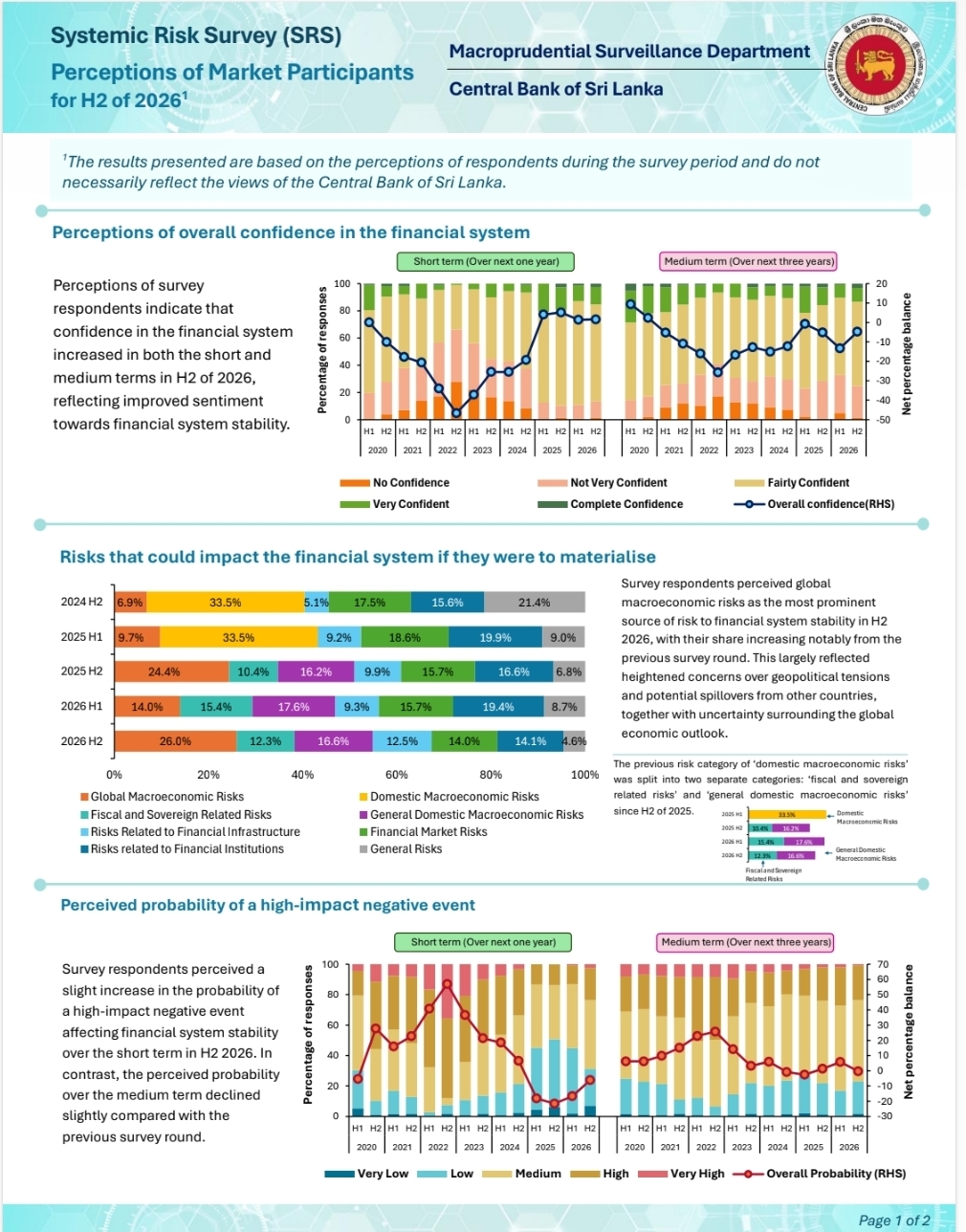

Global macroeconomic risks have emerged as the most prominent threat to Sri Lanka’s financial system, according to the Central Bank’s latest Systemic Risk Survey (SRS), amid heightened geopolitical tensions and uncertainty over the global economic outlook.
The Central Bank said global macroeconomic risks accounted for 26% of perceived risks in the second half of 2026, up sharply from 14% in the first half of the year.
The increase was largely attributed to concerns over geopolitical tensions, potential spillovers from other countries and uncertainty surrounding the global economic outlook.
However, overall confidence in Sri Lanka’s financial system improved during the same period.
According to the survey, respondents reported increased confidence in financial system stability over both the short term — the next one year — and the medium term — the next three years.
Meanwhile, perceptions of the likelihood of a high-impact negative event affecting financial system stability showed a mixed trend.
Respondents perceived a slight increase in the probability of such an event occurring over the next year, while the perceived probability over the next three years declined slightly compared with the previous survey.
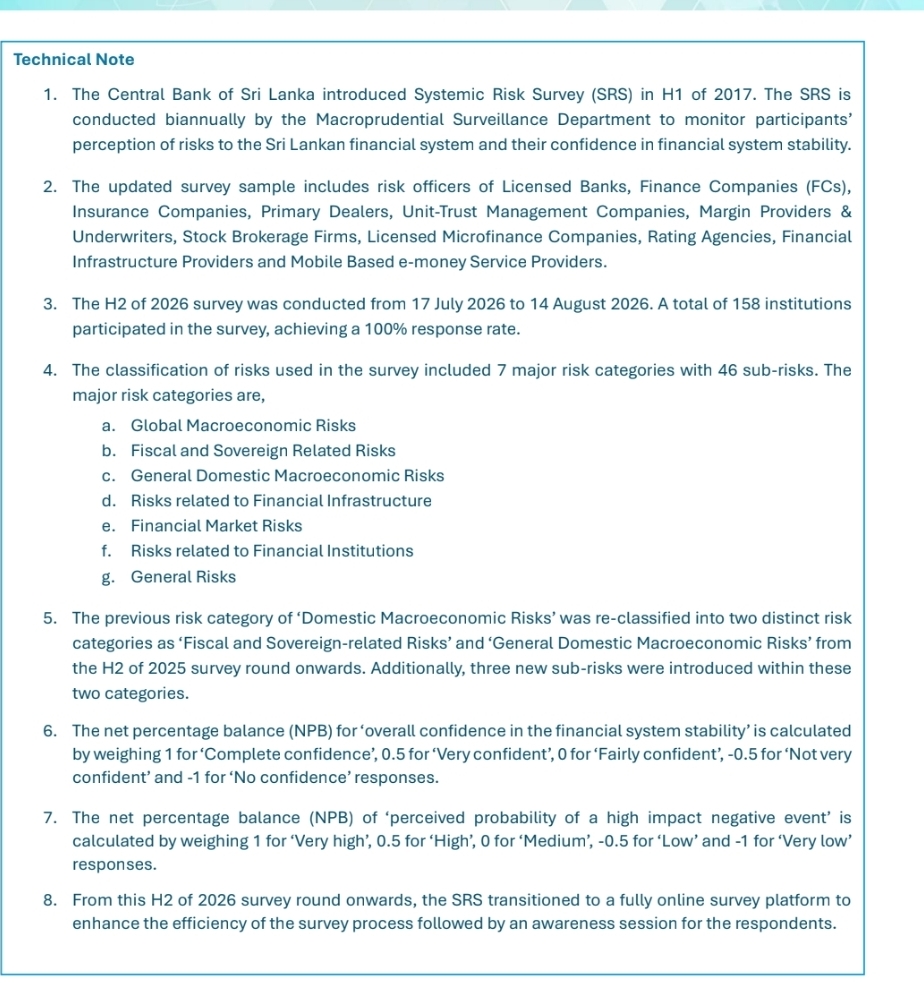
The survey assessed seven broad risk categories, including global macroeconomic risks, fiscal and sovereign-related risks, general domestic macroeconomic risks, financial infrastructure risks, financial market risks, risks related to financial institutions and general risks.
The H2 2026 survey was conducted by the Central Bank’s Macroprudential Surveillance Department from July 17 to Aug. 14, with 158 institutions participating and a 100% response rate.
The Central Bank noted that the findings represent the perceptions of survey respondents and do not necessarily reflect the views of the bank itself.