

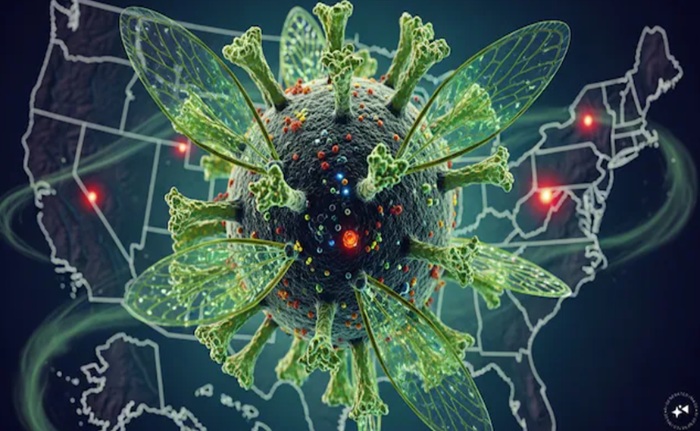
A newly identified and highly mutated COVID-19 subvariant, BA.3.2, informally dubbed the ‘Cicada’ variant, has drawn global attention after being detected in 23 countries, including the United States.
Health authorities, including the Centers for Disease Control and Prevention and the World Health Organization, have confirmed that the strain is being closely monitored due to its unusual mutation profile and potential to partially evade immunity.
According to recent updates, BA.3.2 has been identified in at least 23 countries and multiple US states through routine surveillance. While it currently accounts for a relatively small share of cases in the US, it has seen a notable rise in parts of Europe, where it represents a significant proportion of infections in some regions.
The variant, which evolved from the Omicron lineage of the SARS-CoV-2 virus, was first detected in late 2024 in South Africa and has since spread internationally. Its nickname, ‘Cicada,’ reflects the possibility that it evolved undetected for a prolonged period before re-emerging.
What has particularly concerned researchers is its high number of mutations, over 50 in the spike protein and more than 70 compared to the original strain, raising questions about transmissibility and immune escape.
Despite these concerns, early assessments suggest that BA.3.2 does not appear to cause more severe illness than previous Omicron subvariants. Health data so far indicates no significant increase in hospitalisations or mortality rates, with most infections presenting mild symptoms.
Experts have emphasised that existing vaccines are still expected to offer protection against severe disease, even if their effectiveness against infection may be reduced.
What is the COVID variant ‘Cicada’ (BA.3.2)?
The BA.3.2 COVID-19 variant, commonly referred to as ‘Cicada,’ has been named for its ability to remain largely undetected for a long period before resurfacing. According to Dr Robert H. Hopkins Jr., medical director of the National Foundation for Infectious Diseases, the variant was nicknamed after the rarely emerging insects. It was first identified in June 2025 in an individual travelling to the United States from abroad.
The first case within the US was diagnosed in January, as per a report in USA Today. Since then, surveillance data has shown its presence in wastewater samples collected from 132 locations across at least 25 states, as well as in voluntary nasal swab samples from international travellers.
As per the report, cases of the variant began to rise globally around September 2025.
Experts describe BA.3.2 as a ‘highly mutated’ strain, carrying approximately 70 to 75 mutations. This makes it significantly different from the JN.1 lineage, which has been the dominant COVID-19 strain in the United States over the past two years.
Symptoms linked to BA.3.2 COVID-19 variant
BA.3.2 symptoms are comparable to those of other Omicron subvariants and are generally mild in vaccinated persons. Common symptoms linked to the variant include cough, fatigue, sore throat, runny nose, mild fever, and body aches.
Less frequent symptoms such as loss of taste or smell, night sweats, and skin rashes have also been reported in some cases.
What it means for India and the world
Although the BA.3.2 ‘Cicada’ variant has been reported in several countries, there is currently no indication of a widespread outbreak in India. However, experts caution that in an increasingly interconnected world, international travel can enable new variants to spread rapidly across borders.
Health authorities advise the public to remain cautious and proactive. Key recommendations include staying up to date with booster vaccinations, maintaining basic precautions in high-risk settings, getting tested if symptoms appear, and ensuring the protection of vulnerable groups such as the elderly and immunocompromised individuals.
The emergence of variants like BA.3.2 underscores the ongoing evolution of the COVID-19 virus and the importance of continuous monitoring. While the variant’s high number of mutations and potential to partially evade immunity have drawn scientific attention, there is no current evidence to suggest it causes more severe illness or poses a major global threat.
Experts stress that vigilance, not panic, is essential at this stage. Vaccination, sustained surveillance, and public awareness continue to be the most effective strategies in managing the impact of emerging COVID-19 variants. (CNBC)