

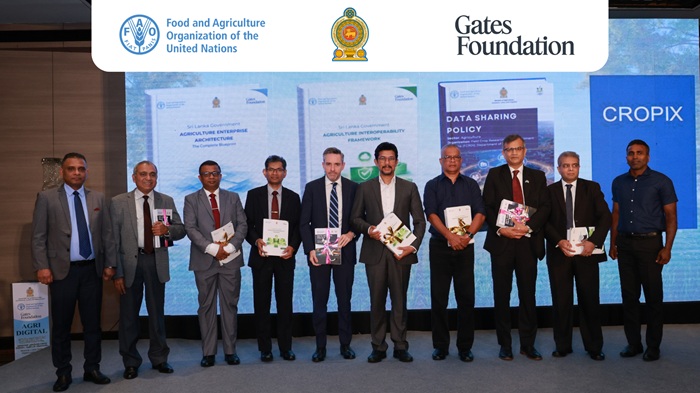
Sri Lanka today officially launched the Agriculture Enterprise Architecture Framework, Agriculture Interoperability Framework, Data Sharing Policies, and CROPIX, a national digital platform for crop data and decision-making.
The high-level launch event, co-hosted by the Ministry of Agriculture, Livestock, Land and Irrigation and the Food and Agriculture Organization of the United Nations (FAO) with funding from the Gates Foundation, marked the formal introduction of a unified digital foundation designed to modernize agricultural governance, improve service delivery, and enable evidence-based decision-making across the sector.
Together, these initiatives form the backbone of Sri Lanka’s emerging Digital Public Infrastructure (DPI) for agriculture, addressing long-standing challenges related to fragmented data systems, institutional silos, and limited data sharing across government entities.
Speaking at the event, Minister of Agriculture, Livestock, Land and Irrigation, K. D. Lalkantha, emphasized the strategic importance of the launch for the sector’s future.
“Today marks a decisive shift in how Sri Lanka governs and supports its agriculture sector. By introducing a unified Enterprise Architecture, Interoperability Framework, and clear Data Sharing Policies, we are laying the foundation for a truly data-driven agriculture system that serves farmers, institutions, and decision-makers alike. CROPIX will enable us to move from fragmented information to informed, timely decisions that strengthen food security and farmer livelihoods,” the Minister said.
Highlighting the importance of interoperability and alignment with the national digital agenda, Deputy Minister of Digital Economy, Eranga Weeraratne, underscored the role of agriculture in Sri Lanka’s wider digital transformation.
“For years, Sri Lanka’s agriculture sector lacked a complete, reliable registry of farmers, lands, and crops—fragmented across systems with duplication and gaps. The solutions launched today change that, introducing a unified, API-driven platform for trusted data-sharing. This will enable smarter policies, targeted services, and innovations like agritech, precision farming, and digital marketplaces—delivering real digital value to those who feed the nation and driving our digital economy forward,” he said.
Chief Advisor to the President on Digital Economy, Dr. Hans Wijayasuriya, highlighted the significance of the initiative within the country’s broader digital transformation agenda.
“What we are witnessing today is the extension of Sri Lanka’s Digital Public Infrastructure into one of our most critical sectors. By applying enterprise architecture, interoperability, and trusted data-sharing principles to agriculture, we are ensuring that digital transformation delivers real value on the ground. This approach enables scalable, secure systems that connect farmers to institutions, data to decisions, and policy to impact,” he said.
The Agriculture Enterprise Architecture Framework provides a strategic blueprint to align people, processes, data, and technology across agricultural institutions, ensuring that digital investments are interoperable, scalable, and future-ready. Complementing this, the Agriculture Interoperability Framework and newly introduced Data Sharing Policies enable secure, standardised, and trusted exchange of agricultural data across ministries, departments, and digital platforms.
At the centre of this digital ecosystem is CROPIX – Crop Resources, Optimizing operations, through Precise Information eXchange System. CROPIX operationalises the architecture and interoperability frameworks by integrating national crop registry, cultivation and production data, forecasting tools, extension services, near real-time field reporting, APIs and Open Data. Through its web platform and mobile applications, CROPIX connects farmers, extension officers, planners, and policymakers around a single, trusted source of agricultural data.
FAO Representative for Sri Lanka and the Maldives, Vimlendra Sharan, highlighted the broader significance of the initiative and FAO’s continued partnership with the Government of Sri Lanka.
“This launch represents more than the introduction of digital systems; it marks a transformation in how data are governed, shared, and used across the agriculture sector. By establishing a strong digital public infrastructure for agriculture, Sri Lanka is positioning itself to respond more effectively to climate risks, improve service delivery, cater to dynamic market demands and make evidence-based decisions that leave no farmer behind. FAO is proud to support this journey towards a resilient, inclusive, and future-ready agriculture sector,” he said.
The launch is expected to accelerate institutional adoption of digital tools within the Department of Agriculture, promote responsible data sharing across government, and foster a culture where near real-time data informs planning, policy formulation, and investment decisions – ultimately ensuring that farmers are the primary beneficiaries through improved services, timely information, and more responsive, evidence-based support.
This milestone marks not just the introduction of new systems, but the beginning of a collaborative national journey towards a resilient, inclusive, and data-driven future for Sri Lanka’s agriculture sector. (Newswire)