

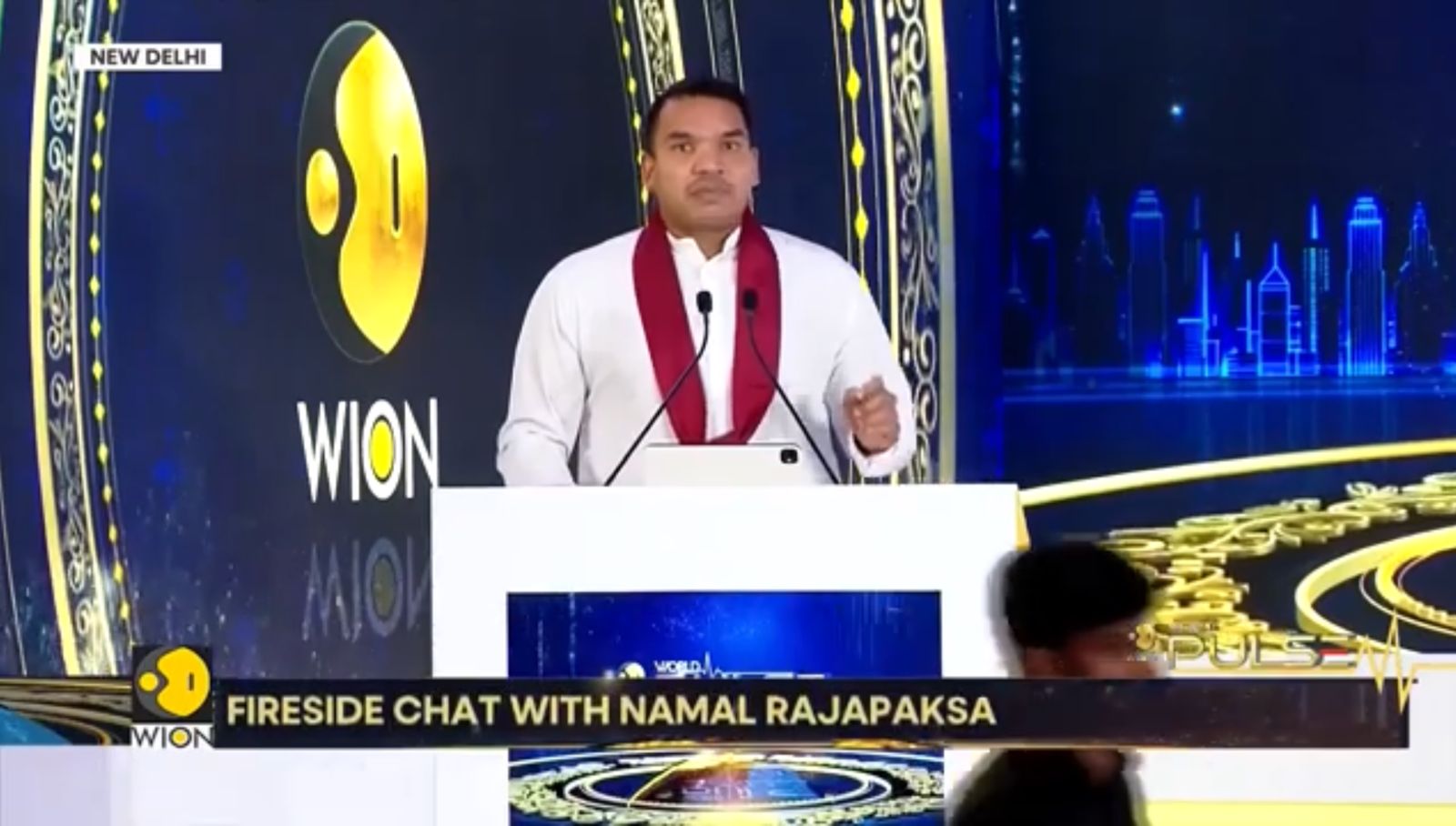
Opposition MP Namal Rajapaksa has highlighted the growing strategic importance of the Indian Ocean, calling for balanced foreign policy and stronger regional cooperation, particularly with Narendra Modi’s India, to navigate a rapidly changing global order.
Addressing the WION Global Summit, Rajapaksa said the global system is undergoing a major transformation, with shifting power dynamics, disruptions to trade routes, technological competition, and ongoing conflicts reshaping international relations. He noted that institutions that once guided global cooperation are now being tested.
He said the post-Cold War world, characterised by economic integration and relative stability, is evolving into a new era of “shared and shifting powers”, where geography is once again becoming central to global politics.
Rajapaksa identified the Indian Ocean as a key region in this transition, noting that nearly two-thirds of global oil shipments and about half of the world’s container traffic pass through its sea lanes. He stressed that undersea cables carrying digital communications also run through the region, making it a critical artery of the global economy.
Highlighting Sri Lanka’s location, he said the country sits at the crossroads of major international shipping routes linking East Asia, the Middle East, and Europe. However, he cautioned that geography alone does not guarantee influence, emphasising the need for careful and balanced foreign policy to protect sovereignty while maintaining strong global partnerships.
Rajapaksa described India’s rise as one of the most significant developments of the 21st century, pointing to its economic growth, technological advancement, and increasing role as a stabilising force in the Indian Ocean. He said Sri Lanka stands to benefit from closer cooperation with India in areas such as maritime security, regional connectivity, and the blue economy.
He also highlighted opportunities for collaboration in emerging sectors, including renewable energy and green hydrogen, suggesting the potential for a South Asian hydrogen corridor supported by regional investment.
On the global stage, Rajapaksa said competition in areas such as artificial intelligence, cybersecurity, and digital infrastructure will shape future power dynamics. He stressed the importance of ensuring that technological advancements create opportunities rather than deepen inequalities, particularly for developing nations.
Concluding his address, he called for the Indian Ocean to remain a zone of peace, cooperation, and shared prosperity, warning that instability in the region would have far-reaching global consequences. (Newswire)