

By Newswire Editorial
Sri Lanka Podujana Peramuna (SLPP) MP Namal Rajapaksa has questioned the government over the status of the US$4 billion Chinese investment announced following President Anura Kumara Dissanayake’s visit to China, alleging that the administration has failed to translate international agreements into actual investments.
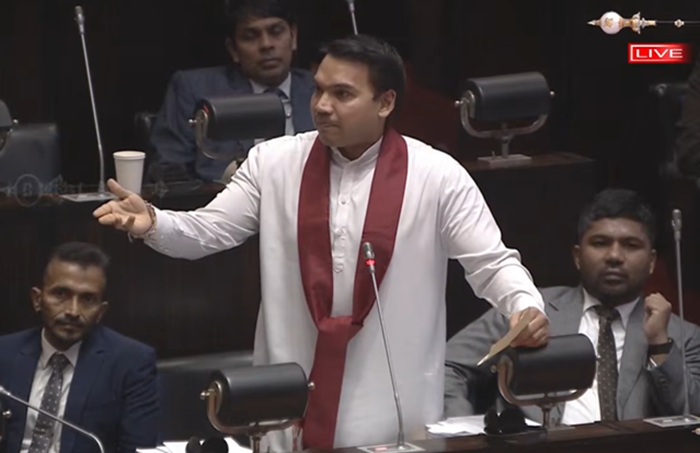
Addressing Parliament today (23), Rajapaksa questioned what steps the government had taken to secure the investment following the President’s discussions with Chinese President Xi Jinping.
“The President signed an agreement with the Chinese President to bring a $4 billion investment to Sri Lanka. Where is that investment now?” he questioned.
Rajapaksa claimed that the government had held several press conferences announcing the investment but had failed to deliver tangible results.
He also accused the administration of driving away foreign investors, including India’s Adani Group and China’s China Merchants, following its assumption of office.
Speaking during the debate on the Ministries of Foreign Affairs, Tourism and Foreign Employment, Rajapaksa further criticised the government’s utilisation of funds allocated for tourism development.
He claimed that of the Rs. 2,119 million allocated for capital expenditure in the previous Budget, including tourism infrastructure development and youth training, only Rs. 420 million had been spent.
According to Rajapaksa, this represented approximately 20% of the allocation, while the government was attempting to portray the remaining Rs. 1.6 billion as savings.
Turning to foreign policy, the SLPP MP questioned the government’s diplomatic priorities, claiming that ambassadorial positions in several important countries, including China, the United States, Germany and Canada, had remained vacant for several months.
He also called for strengthening regional maritime security cooperation, including through the Colombo Security Conclave framework.
On tourism, Rajapaksa questioned revisions to the methodology used to calculate tourism earnings, raising concerns over whether the changes had resulted in inflated revenue figures.
He further accused the government of prioritising large-scale hotel operators while taking action against small and medium-scale tourism establishments in coastal areas, including Mirissa, Unawatuna and Weligama.
Addressing foreign employment issues, Rajapaksa urged the government to resolve concerns surrounding employment opportunities in Israel and explore alternative labour markets amid instability in the Middle East.
He also called on the government to address public sector trade union demands, accusing the administration of failing to honour its election promises concerning salary adjustments.
Rajapaksa urged the government to engage with trade unions and resolve their grievances before the deadline of November 30. (Newswire)