

No content related to Tamil history and artistic heritage has been removed from the subjects of History and Art.
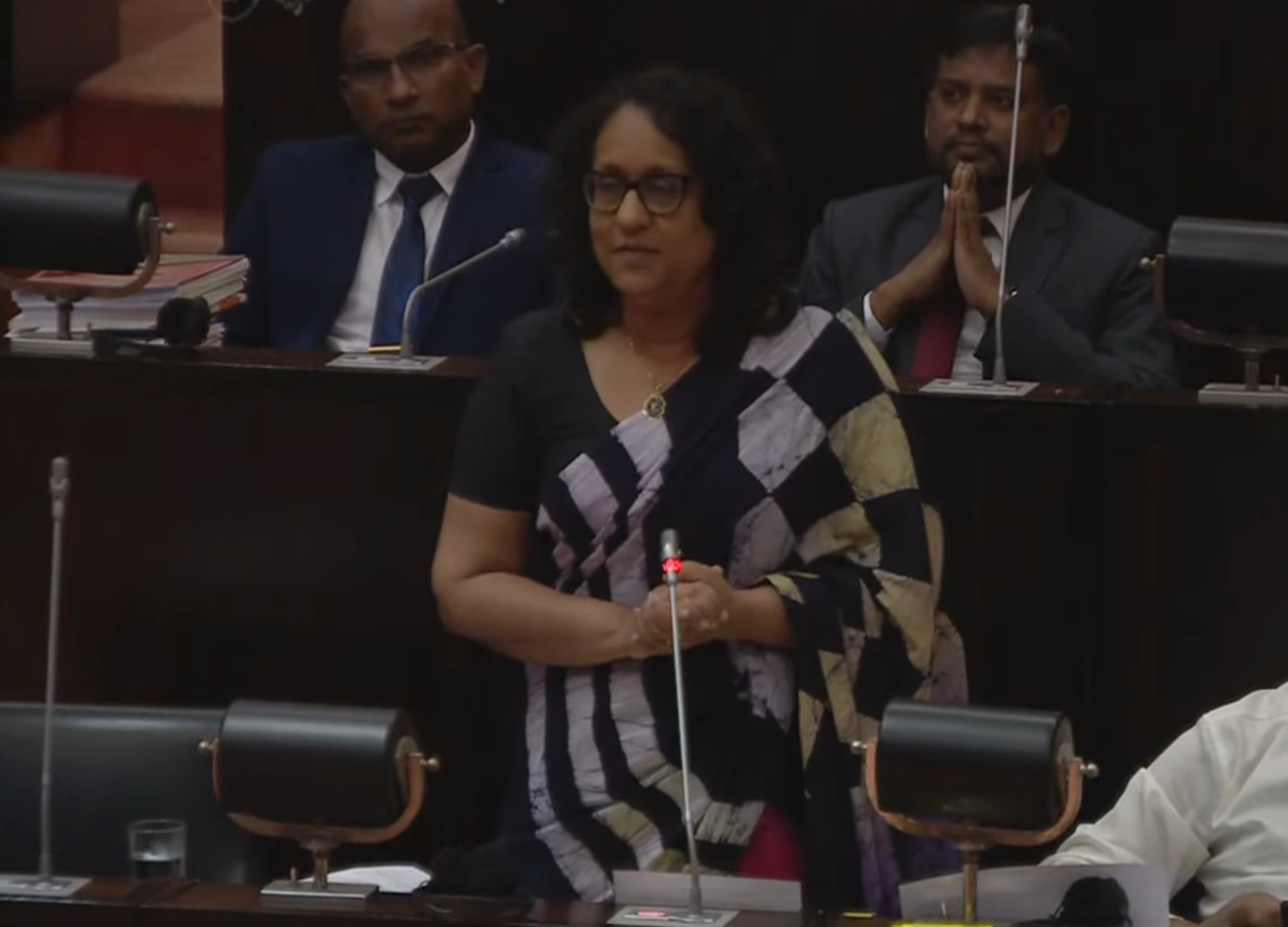
Prime Minister Harini Amarasuriya says no content related to Tamil history and artistic heritage has been removed from the subjects of History and Art.
PM Amarasuriya noted that the currently implemented History syllabus includes content related to Tamil kings.
“History is not taught separately as Sinhala and Tamil. Instead, the subject is taught as Sri Lankan History, covering kings and kingdoms from various historical periods,” she further explained.
PM Amarasuriya further clarified that the Art subject consists of practical activities and the study of significant artworks.
The Prime Minister made this remark while responding to questions raised by Members of Parliament Padmanathan Sathiyalingam and S. Sritharan in Parliament yesterday (03).
“There are two schools located on the island of Eluvaitivu in the Jaffna District. Since 1999, these schools have not been used as examination centres. Students from these schools have been sitting for the Ordinary Level examination at the examination centre of St. Anthony’s College in Kayts. Due to the very small number of students appearing for the examination from the schools on Eluvaitivu Island, those schools have not been maintained as examination centres.
“Statistically, only 10 students applied in 2022, 8 students in 2023, and 5 students in 2024 for the O/L examination. Therefore, these schools were not used as examination centres, and the students were directed to the nearest available examination centre. We also pay attention to ensuring transportation facilities for these students to travel to the examination centres in Kayts,” she said.
PM Amarasuriya also noted that the currently implemented History syllabus includes content related to Tamil kings and that a separate section has been included in Lesson 7 of Grade 10 for this purpose.
“Likewise, Lesson 10 of Grade 10 covers a segment on the Jaffna Kingdom, including content related to the period of Cankili. Under the new education reforms, new recommendations have already been prepared for teaching History in Grade 6, which also include an illustration of the Cankili Kingdom.
“History is not taught separately as Sinhala and Tamil. Instead, the subject is taught as Sri Lankan History, covering kings and kingdoms from various historical periods,” she explained.
The Prime Minister pointed out that the Department of National Museums, as the leading institution responsible for preserving and exhibiting Sri Lanka’s history, has allocated space to display Tamil history.
“The Stone Antiquities Gallery of the Colombo Museum contains four Tamil copper plate inscriptions and two Tamil stone inscriptions. These inscriptions are established by the representatives of Indian emperors Rajaraja and Rajendra, as well as the Aryachakravarti rulers.
“A book containing information about these Tamil inscriptions, authored by Prof S. Pathmanathan, is also available for purchase through the Publications Division of the Department of the National Museum. Moreover, several stone and metal sculptures related to the Hindu religion, including sculptures of Shiva, Parvati, Nataraja, Sundaramurthi, and others, are showcased. Additionally, a collection of Setu coins used during the Jaffna Kingdom is safely preserved.
“The Colombo National Museum also houses a book authored by Dr. Krishnamurthy and Senarath Wickramasinghe on Chola and Pandya coins belonging to the Sangam era,” she said.
PM Harini Amarasuriya further clarified that the Art subject consists of practical activities and the study of significant artworks.
In structuring this subject, special attention has been given to international standards that include multicultural, multi-religious, and universal artistic creations. Particular focus has been placed on this aspect in the recent revisions to the Art curriculum,” she added. (Newswire)