

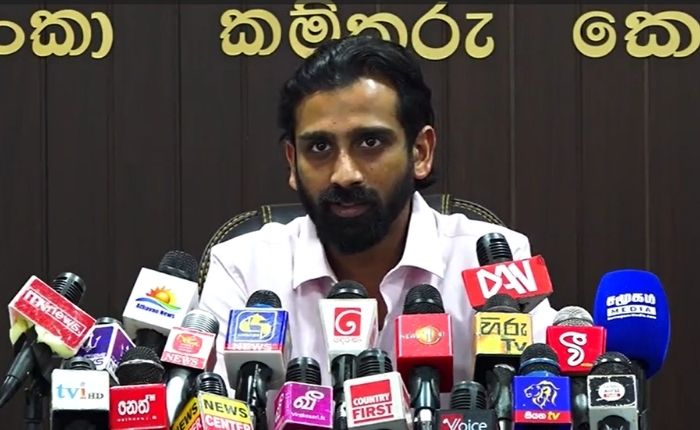
MP Jeevan Thondaman, General Secretary of the Ceylon Workers Congress, has sharply criticized the government’s handling of the recent agreement to increase daily wages for estate workers, accusing officials of a lack of transparency and failing to provide legal protections for workers.
Speaking at a press briefing, Thondaman stressed that there was no opposition to the wage hike itself, but raised serious concerns about the manner in which it is being implemented. “We voted in favour of the budget. I’ve always supported the wage hike,” he said, rejecting claims that opposition parties, including Opposition Leader Sajith Premadasa, opposed the development.
The agreement, signed between the government and Regional Plantation Companies (RPCs) on January 30, 2026, raised the basic daily wage from Rs. 1,350 to Rs. 1,550, with an additional Rs. 200 provided as a daily attendance incentive.
Under the new wage structure, the current daily wage of Rs. 1,350 will rise by Rs. 400. Of this increase, plantation companies will provide Rs. 200, while the government will contribute the remaining Rs. 200 as financial support. The revised wage will be paid to workers starting Feb. 10, officials said.
However, Thondaman questioned the credibility of RPCs claiming financial losses, pointing out that no business would continue for decades without profit. “How can a company be making loss for 20 years? That’s a complete lie. If companies have been making losses for 20 years, why do they still hold on to the estates? They’re not charities,” he said, accusing the government of subsidizing “loss-making” entitites with public funds.
Thondaman also challenged the government’s shift from an initially promised Rs. 2,138 daily wage to the current Rs. 1,750 combined total.
“First of all the government promised a Rs. 2,138 basic salary. When we proposed Rs. 1,700 they said, we cannot accept it, we need Rs. 2,138. Inflation at that point of time was 1.5% and climbing down. After the elections, inflation is now roughly about 3 to 5%. And are you telling me now, that Rs. 2,138 doesn’t matter to the workers?” he questioned.
The MP also accused the government of withholding the full text of the agreement from the public, civil society, and even Parliament, despite repeated requests.
“We have a copy of the agreement. If I am wrong, let the government table the actual document in Parliament,” he said.
Citing specific provisions in the document, Thondaman raised concern over a clause requiring 180 days of attendance per year for workers to qualify for gratuity. “Gratuity should be available even if a worker works a single day,” he said, stating that companies are exploiting loopholes by keeping workers unregistered, denying them EPF, ETF, maternity and other benefits.
He also pointed to a clause which reportedly states that the Memorandum of Understanding (MoU) between the government and plantation companies is not legally binding. “What’s the point of spending public money to hold ceremonies and publish advertisements if the agreement has no legal weight? Without a gazette notification, there is no accountability.”
Thondaman urged the government to gazette the agreement through the Ministry of Labour to make it enforceable, protecting workers, while holding companies accountable.
He also expressed concern that in some estates, the wage hike has been tied to increased workloads, with plucking quotas raised from 20 to up to 26 kilograms per day. “This is not a real wage increase if workers are forced to do more for it,” he said.
The MP warned that temporary financial subsidies must not come at the cost of long-term labour rights, urging the government to engage directly with estate workers and avoid politicizing their struggles.
The wage increase follows a series of proposals under the 2025 Budget, with Rs. 5 billion allocated in the 2026 Budget to support the adjustment.
The government has described the move as the largest salary increase for estate workers in Sri Lanka’s history, amid a broader push to improve conditions in the plantation sector. (Newswire)