

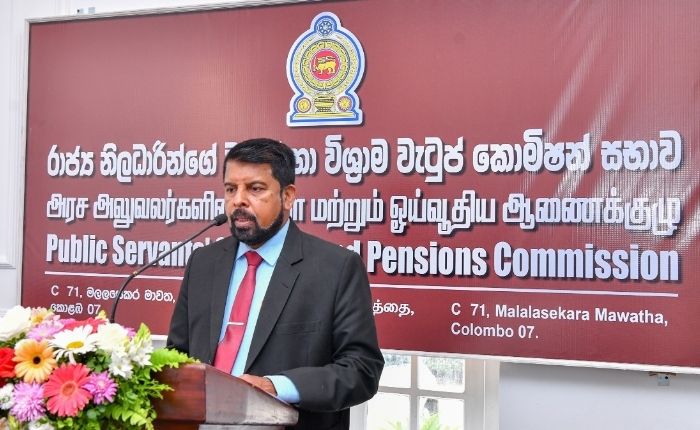
Sri Lanka launched the Public Officers’ Salaries and Pensions Commission, the country’s first dedicated body tasked with addressing pension-related issues affecting retired public servants while also reviewing salary anomalies and recommending reforms to modernize the public service.
The 15-member Commission officially commenced operations at its office on Malalasekara Mawatha in Colombo under the patronage of Minister of Public Administration, Provincial Councils and Local Government Professor Chandana Abeyratne.
It was established following a proposal presented by President Anura Kumara Dissanayake in the 2026 Budget and was formally gazetted on June 22, 2026. Former Ministry Secretary Ashoka Peiris chairs the Commission, with Nalaka Disanayake serving as Secretary.
The Commission has been mandated to recommend solutions to longstanding salary and pension issues affecting public officers, promote professionalism within the public service, and advise on structural reforms needed to modernize the sector in line with emerging technologies and global trends.
Addressing the inaugural ceremony, Professor Abeyratne said no commission had been appointed to examine public sector salary issues for more than two decades and that this was the first time Sri Lanka had established a dedicated commission to address pension-related concerns of retired public officers. He said the government intended to adopt a comprehensive, evidence-based approach rather than piecemeal solutions to longstanding issues.
The Minister said the salary increase announced in the President’s first Budget is being implemented in three phases from Jan. 1, 2025, to Jan. 1, 2027, and that the revised salary scales would also apply to public officers who retired on or after Jan. 1, 2025, for pension calculation purposes. He also noted that recruitment to the public service, suspended since 2020, had resumed, with Cabinet approving the recruitment of 120,000 new public servants.
Deputy Minister of Labour Mahinda Jayasinghe said previous attempts to address salary anomalies had failed to produce satisfactory outcomes and expressed confidence that the new Commission would adopt a comprehensive and scientific approach to resolving the issues. He added that the Commission’s mandate extended beyond salary anomalies to include improving professionalism across the public service.
The government has opened a two-month period from Aug. 4 for trade unions, professional organizations and members of the public to submit views, concerns and proposals to the Commission. A trilingual public notice outlining the submission process is scheduled to be published in newspapers this week. (Newswire)