

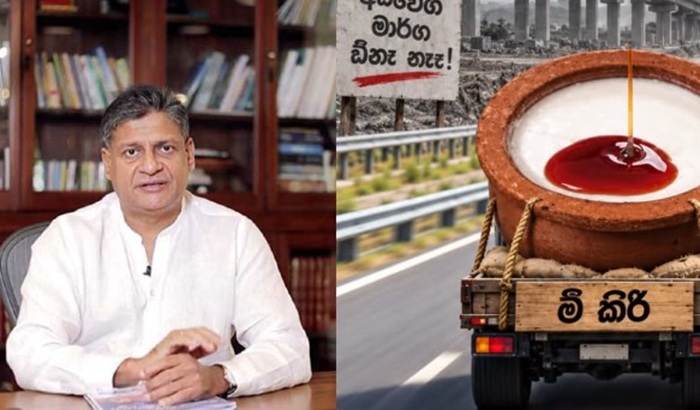
Sarvajana Balaya MP Dilith Jayaweera has cautioned that the government’s announcement to construct three expressways from next year using “domestic funds” without foreign loans is misleading, arguing that the plan conceals the real financial and foreign exchange burden on the country.
Issuing a statement, Jayaweera said domestic funds are not free money, but consist of taxes collected from citizens and borrowings from the local market. If Rs. 2 trillion is to be spent on expressways, he noted, the government would have to raise the money either by imposing more taxes, cutting essential expenditure, or borrowing further from the domestic market.
According to projections, government revenue in 2027 is estimated at Rs. 5.8 trillion. Of this, Rs. 2.64 trillion will be spent on interest payments, while Rs. 3.39 trillion will be required for salaries, pensions, subsidies, and other recurrent expenses. Jayaweera pointed out that mandatory spending already exceeds revenue before any capital allocation is made. He added that under the IMF programme, Sri Lanka must maintain a primary surplus of 2.3% of GDP, making it unclear how Rs. 2 trillion could be allocated solely for expressways under such strict fiscal limits.
He stressed that paying contractors in rupees does not make the projects dollar‑free. Large volumes of steel, bitumen, fuel, heavy machinery, vehicles, tyres, spare parts, lubricants, electrical and electronic equipment, signalling and toll systems must be imported. Even cement and concrete produced locally involve foreign exchange costs for clinker, fuel, power, and machinery. Sand, stone, and gravel may be domestic resources, but the fuel and equipment used in extraction and transport are imported. If foreign labour is employed, wages and remittances will also contribute to dollar outflows.
Jayaweera warned that considering direct imports, hidden imports within domestic supplies, foreign labour, machinery maintenance, and additional import demand, the foreign exchange exposure could reach nearly 90% of the project cost. A Rs. 2 trillion programme, he said, could generate foreign exchange demand equivalent to almost USD 6 billion.
He further highlighted that challenges in 2028 will be even more severe. According to IMF projections, Sri Lanka’s official reserves must rise to USD 13.9 billion by then, a target achievable only through sustained growth in exports, tourism, remittances, and foreign direct investment. At the same time, servicing restructured bilateral and commercial debt will increase, with annual requirements estimated between USD 3.2 billion and USD 5 billion. By 2028, the government will therefore face three simultaneous tasks: building reserves to USD 13.9 billion, meeting rising debt obligations, and maintaining a primary surplus of 2.3% under the IMF programme.
Against this backdrop, Jayaweera argued that starting three expressways at once, projects that could add billions of dollars in foreign exchange demand, is economically impractical. He stressed that this is not opposition to expressway development, which Sri Lanka needs, but a call for clear priorities, realistic timelines, and an economic plan to earn the foreign exchange required.
He described the claim of “building expressways from domestic funds without foreign loans” as a half‑truth, saying it only refers to payments in rupees while hiding the real dollar burden. Jayaweera urged the government to present Parliament and the public with the full estimated costs of each expressway, annual Treasury allocations, a complete assessment of foreign exchange impacts, the sources of required dollars, and how the expenditure aligns with IMF fiscal limits and debt servicing obligations.
Without such transparency, he warned, the promise is not a development plan but a political pledge without financial backing. He concluded that Sri Lanka must first build a productive economy that will use these roads, industries that earn dollars, stronger exports, and greater foreign investment, before embarking on mega projects that risk deepening the country’s economic crisis. (Newswire)