

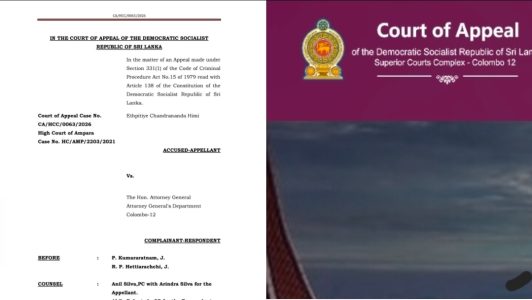
The Court of Appeal has upheld a 14-year rigorous imprisonment sentence imposed on a Buddhist monk convicted of sexually abusing an 11-year-old boy at a temple in the Ampara District.
The judgment, delivered on November 17 by Justices P. Kumararatnam and R.P. Hettiarachchi, dismissed an appeal filed by Ethpitiye Chandrananda Himi against his conviction and sentence.
According to court documents, the victim had visited the Siwminiseya Temple with his parents when the chief priest invited children to enter the Buddhist priesthood.
The boy subsequently became a novice monk and remained at the temple, where he was subjected to repeated sexual abuse over approximately 10 months in 2014.
The incident came to light following a complaint made by a police officer who had been on duty at the temple.
During the trial, the victim, who was 19 years old when he testified, described the abuse he had suffered while under the monk’s guardianship.
Medical evidence presented before the court also supported the prosecution’s case.
The Ampara High Court convicted the monk of one count of grave sexual abuse and sentenced him to 14 years of rigorous imprisonment.
He was also ordered to pay a fine of Rs. 40,000 and compensation of Rs. 500,000 to the victim.
The monk appealed against the conviction, arguing that the prosecution had failed to establish the case beyond reasonable doubt, that the defence evidence had not been properly considered and that the sentence was excessive.
However, the Court of Appeal rejected these arguments, finding that the trial judge had properly assessed the evidence.
The Court observed that the monk had occupied a position of trust and authority over the child and had abused that position.
It also noted that the victim had provided firm evidence without major contradictions.
Accordingly, the Court dismissed the appeal and upheld the 14-year prison sentence, ordering that it be calculated from January 16, 2026, the date of the High Court judgment. (Newswire)