

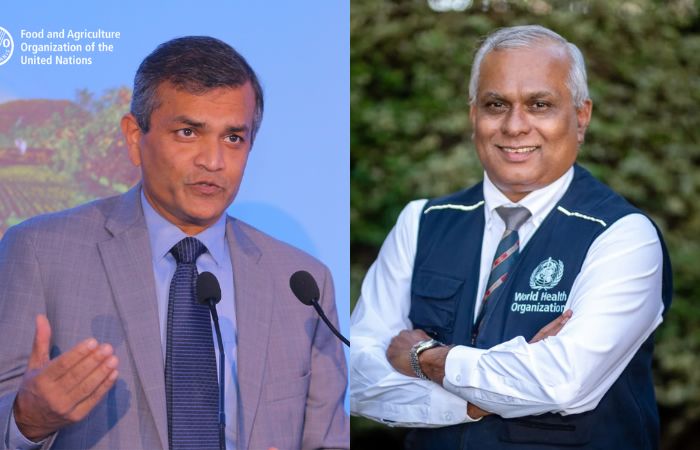
By Vimlendra Sharan, FAO Representative in Sri Lanka and the Maldives, and Dr. Rajesh Sambhajirao Pandav, WHO Representative to Sri Lanka
An antibiotic that no longer works is more than a medical concern. It can mean a child’s infection becomes harder to treat, a farmer loses valuable livestock, or a food producer faces higher costs and reduced market opportunities. Antimicrobial resistance (AMR) is already affecting lives, livelihoods and economies. It demands action not only in hospitals, but also on farms, in food systems, in our communities and across the environment.
This is the message of World AMR Awareness Week, observed from 18 to 24 November 2026 under the theme “One Health, one action: Prevent AMR now”. It reminds us that every decision matters: how antimicrobials are prescribed and used, how infections are prevented, how animals are raised, and how medicines and waste are managed. Protecting the effectiveness of these essential medicines is a shared responsibility.
The AMR Challenge: Why Action Cannot Wait
The scale of the challenge is sobering. In 2021, bacterial AMR is associated with more than 4.7 million deaths annually worldwide and without urgent action, AMR could cause up to 39 million deaths by 2050, and cost the global economy more than US$3.4 trillion annually, disproportionately affecting low- and middle-income countries.
The consequences extend far beyond these numbers. AMR can prolong illness and hospital stays, increase the need for expensive second-line treatments and make routine medical procedures such as surgery, childbirth and cancer treatment considerably riskier. At the same time, resistance threatens animal health, agricultural productivity, food security and trade, with serious implications for smallholder farmers and communities whose livelihoods depend on healthy animals, sustainable fisheries and resilient food systems.
Resistance also does not stop at the boundaries of hospitals, farms or households. Resistant organisms and antimicrobial residues can move through wastewater and waste from healthcare, agriculture, animal production, aquaculture and communities. Stronger sanitation, waste management and environmental surveillance are therefore an important part of closing these pathways.
This is why preventing infections and using antimicrobials responsibly are ultimately investments in both health and development. And because resistance moves between people, animals, food and the environment, no single sector can address it alone.
Sri Lanka’s One Health Response
Sri Lanka has an important foundation on which to build. Its first National Strategic Plan for Combating AMR introduced in 2017 recognizes that effective action must connect human health, veterinary services, agriculture and the environment, and helped broaden the national response beyond viewing AMR primarily as a hospital prescribing issue. The current National Strategic Plan for 2023–2028 takes this further, recognizing that effective action must connect human health, animal health, agriculture, aquaculture, food production and the environment.
Surveillance is central to this response. Since establishing a national coordinating centre for AMR surveillance in 2018, Sri Lanka has strengthened laboratory-based data collection through WHO’s WHONET platform and participation in the Global Antimicrobial Resistance and Use Surveillance System, while FAO’s collaboration with national partners is helping advance surveillance across animal health, fisheries and food-production systems. Together with growing attention to environmental surveillance, these efforts support a more integrated understanding of resistance across sectors.
Alongside stronger surveillance, Sri Lanka is strengthening antimicrobial stewardship, including through WHO’s Access, Watch and Reserve classification, while advancing infection prevention, responsible use and action on environmental pathways.
Bringing Complementary Expertise to Action
The Food and Agriculture Organization of the United Nations (FAO) works with national institutions, including the Department of Animal Production and Health (DAPH), and partners across the One Health sectors to translate these commitments into practical improvements. Our approach is straightforward: prevent infections wherever possible; strengthen the evidence needed to identify and understand resistance; and equip professionals and producers to use antimicrobials responsibly when they are genuinely needed.
Across livestock, aquaculture and food production, this work supports healthier production systems that reduce the need for antimicrobials while protecting animal health, food safety and livelihoods.
The World Health Organization (WHO) works with the Ministry of Health and One Health partners across the continuum of Sri Lanka’s response to AMR. Through the Fleming Fund, WHO has supported stronger laboratories and surveillance across human and animal health, fisheries, aquaculture and the environment, including capacity at the Medical Research Institute, Veterinary Research Institute, National Aquatic Resources Research and Development Agency and environmental-sector laboratories.
Support for antimicrobial stewardship complements these investments, linking the ability to detect and understand resistance with better antimicrobial use, clinical practice and public-health action.
These important contributions converge around a shared priority: preventing infections and preserving effective antimicrobials for people and animals who genuinely need them.
Pandemic Fund: Turning Commitments into Capacity
An important opportunity to accelerate this work is Sri Lanka’s Pandemic Fund project, “One Vision, One Shield: Sri Lanka’s Integrated One Health Pandemic Preparedness & Response”.
Implemented through collaboration among national authorities and international partners, including FAO, WHO, UNICEF, the World Bank and the Asian Development Bank, the project is strengthening surveillance, laboratory systems and workforce development across human, animal and environmental health. These are also essential foundations for a stronger national response to AMR.
Tangible progress is being made. FAO has supported national assessments and planning processes to identify surveillance, laboratory and workforce needs, and has advanced training and coordination activities that bring animal health, wildlife, environmental, aquatic and other stakeholders together. Work on laboratory assessments and improvement plans is helping to establish priorities for better diagnostics, biosafety and quality management. Support for AMR surveillance, antimicrobial stewardship and professional capacity development is being aligned with these wider investments, so that the country can generate more reliable evidence and act on it.
This work builds on earlier investments through the Fleming Fund, which helped strengthen AMR surveillance and laboratory capacity across human health, animal health, fisheries, aquaculture and the environmental sector. Connecting these capacities can help Sri Lanka generate more reliable evidence and translate it into coordinated action.
AMR-MPTF: Building on the Pandemic Fund Investment
Sri Lanka has also received a new investment of 1 million USD through the Antimicrobial Resistance Multi-Partner Trust Fund (AMR-MPTF). This provides a timely opportunity to reinforce national action on AMR and will be closely aligned with the Pandemic Fund project. Rather than creating parallel efforts, the two investments will be mutually reinforcing: the Pandemic Fund strengthens the underlying surveillance, laboratory and workforce capacities, while the AMR-MPTF helps advance more focused, coordinated AMR interventions, responsible antimicrobial use and multisectoral implementation. Together, they offer a pathway from improved readiness to sustained prevention and measurable results.
Aligning National Action with the Global AMR Agenda
This direction is consistent with the updated Global Action Plan on AMR 2026–2036, adopted by the World Health Assembly in May 2026. Developed through the Quadripartite collaboration of FAO, WHO, the World Organisation for Animal Health and the United Nations Environment Programme, the Plan places One Health at the centre of action. It emphasizes preventing infections, strengthening surveillance, promoting responsible and equitable antimicrobial use, reducing risks in agrifood systems and limiting environmental contamination. Crucially, it calls for national commitments to be matched by financing, monitoring and accountability.
From Investment to Lasting Impact
For Sri Lanka, the next phase must therefore be judged not only by the number of workshops held or equipment procured, but by the changes these investments make possible: stronger surveillance and reporting, better laboratory-supported decisions, safer prescribing, improved biosecurity, more responsible antimicrobial use and closer collaboration across institutions.
Lasting progress will also depend on the everyday decisions made across health services, farms, food systems, communities and the environment.
One Health, One Action: A Shared Responsibility
Around the world, governments, health professionals, veterinarians, environmental experts, farmers, researchers and communities are already taking action to prevent AMR.
They are improving access to antimicrobials, promoting their responsible use and safe disposal, strengthening water, sanitation and hygiene, advancing sustainable food systems, improving access to diagnostics and vaccines, reducing pollution and protecting the environment. Every action matters.
World AMR Awareness Week is an invitation to further act at every level. Policymakers can prioritize coordinated, adequately resourced national action. Veterinarians and health professionals can promote appropriate prescribing and infection prevention. Farmers and food businesses can strengthen hygiene and biosecurity and follow professional guidance on treatment and withdrawal periods. Researchers, laboratories and environmental practitioners can help close critical evidence gaps. Communities can use antimicrobials responsibly, avoid self-medication and dispose of unused medicines safely.
FAO and WHO remains committed to supporting Sri Lanka and its national partners in this effort. With the foundations established through the Pandemic Fund, the additional opportunity provided by the AMR-MPTF and the direction set by the Global Action Plan 2026–2036, the country has a valuable chance to turn shared ambition into lasting national capacity.
The central message of WAAW 2026 is both urgent and hopeful: we do not have to wait for resistance to become a crisis before acting.
One Health is our shared approach; prevention is our common purpose. One action at a time, we can safeguard the medicines we depend on, the food systems that sustain us and the health of future generations.