

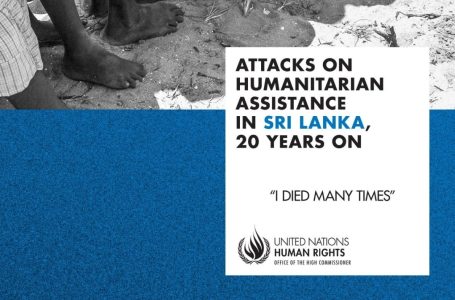
The United Nations Human Rights Office (OHCHR) has called on the Sri Lankan Government to formally acknowledge attacks against humanitarian and medical personnel during the armed conflict, issue a public apology and provide comprehensive reparations to victims and their families.
In a new 40-page report titled “I Died Many Times: Attacks on Humanitarian Assistance in Sri Lanka, 20 Years On,” the OHCHR said accountability for serious violations of international law during the conflict remains largely absent.
The report found that attacks against humanitarian workers, hospitals and relief operations, particularly between 2006 and May 2009, formed part of a sustained pattern rather than isolated incidents.
It accused successive Sri Lankan governments of failing to credibly investigate or prosecute attacks involving the Sri Lankan military, the Liberation Tigers of Tamil Eelam (LTTE) and other armed groups.
The report examined four major incidents:
* The disappearance of Tamil Rehabilitation Organisation staff in January 2006.
* The killing of 17 Action Contre la Faim humanitarian workers in Muttur in August 2006.
* The shelling and obstruction of a UN humanitarian convoy in January 2009.
* The shelling of Puthukkudiyiruppu Hospital in 2009.
According to the OHCHR, no individual has been held criminally responsible in any of the four cases.
The report also acknowledged that restrictions imposed by both the Government and the LTTE weakened humanitarian operations and increased civilian suffering.
The UN further acknowledged its own institutional failures during the conflict, including its failure to adequately protect civilians and respond to early warnings.
Key recommendations
The OHCHR called on Sri Lanka to:
* Issue a public apology and provide reparations to victims and their families.
* Establish an independent prosecutorial mechanism.
* Investigate whether attacks and restrictions on humanitarian assistance formed part of a broader policy or plan.
* Incorporate war crimes and crimes against humanity into domestic legislation.
* Accede to the Rome Statute of the International Criminal Court.
* Reform the security sector and strengthen victim and witness protection.
* End intimidation and surveillance of victims, human rights defenders and journalists.
The report also recommended international investigations, prosecutions, targeted sanctions and human rights vetting of Sri Lankan security personnel where domestic accountability efforts remain inadequate.
The OHCHR said it submitted 27 questions to the Sri Lankan Government on September 24, 2026, and subsequently shared an advance copy of the report on November 3, inviting comments.
However, it said no response had been received from the Government at the time of publication. (Newswire)