

By Newswire Editorial
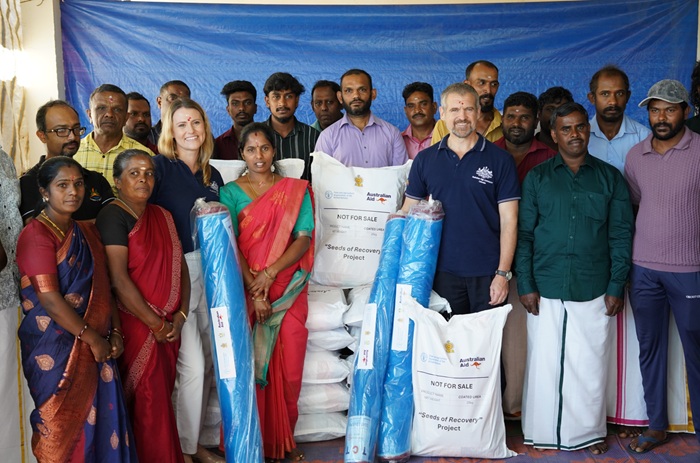
The Food and Agriculture Organization of the United Nations (FAO), with funding from the Australian Government, is supporting 1,600 smallholder farmers in the Nuwara Eliya and Badulla districts to restore vegetable production following the devastation caused by Cyclone Ditwah.
Issuing a statement today (27), the FAO said the 12-month project aims to restore local seed production systems, improve access to quality planting materials and promote climate-smart agricultural practices.
The project is being implemented in collaboration with the Department of Agriculture and Provincial Departments of Agriculture, with funding from the Australian Government through its Department of Foreign Affairs and Trade (DFAT).
Cyclone Ditwah caused significant damage to vegetable cultivation in Sri Lanka’s central highlands, affecting farmland, agricultural assets and the livelihoods of smallholder farming communities.
Under the initiative, 800 bean seed farmers in the Nuwara Eliya District will receive support and be organized into 40 farmer clusters to facilitate knowledge-sharing, collective action and farmer training.
As part of the first phase, 280 bean seed farmers in the Mathurata region received certified bean seeds and technical guidance on quality seed production and national seed certification procedures.
The second phase is scheduled to commence in December 2026, aiming to reduce farmers’ reliance on external seed suppliers and create opportunities to participate in local seed markets.
Meanwhile, another 800 farmers, comprising 400 each from the Nuwara Eliya and Badulla districts, will receive assistance to restore potato cultivation, with each selected farmer receiving 2,500 quality seed potato tubers.
The first phase of this intervention commenced in August 2026, benefiting 38 farmers in the Ragala area of Nuwara Eliya, while the next phase of distribution is scheduled to commence towards the end of November.
The project also provides agricultural inputs, training and technical assistance to improve crop productivity and produce quality.
The FAO said the initiative aims to help farmers rebuild their agricultural livelihoods while strengthening the resilience of vegetable production systems against future climate-related shocks. (Newswire)