

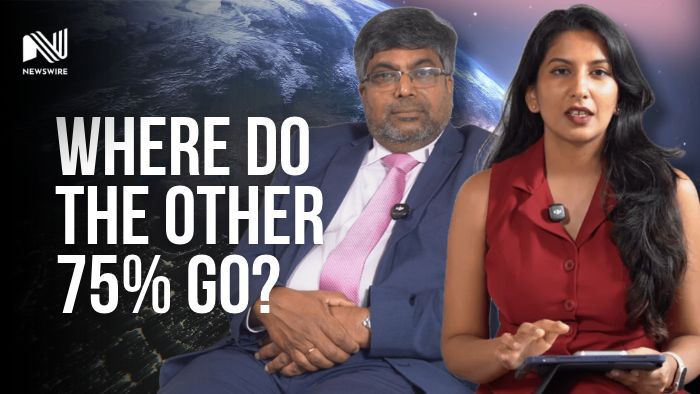
After meeting Prime Minister Harini Amarasuriya, Jaffna-born Professor Sir Nishan Canagarajah, President and Vice-Chancellor of the University of Leicester, sat down with Newswire to talk about the 75% of students who don’t make it into university here, and what Leicester wants to do about it.
Full interview below:
Newswire: You went from Tamil-medium classrooms in wartime Jaffna to Cambridge. What was that like?
Sir Nishan Canagarajah: I studied at St John’s in Jaffna in Tamil, and I was about to enter the University of Peradeniya to do engineering, but I got the scholarship to go to Cambridge. I had to start learning in English. One benefit of doing engineering is that a lot of the mathematics is similar in Tamil and English. Still, learning the language, the terms, the culture and its idiosyncrasies was a bit tough initially.
Newswire: You were the first in your batch to graduate from any university. What happened to the classmates who didn’t get this chance?
Sir Nishan Canagarajah: I left in 1986, and there was a lot of disruption to university education in Sri Lanka at that time, so it took them a lot longer to complete. At Cambridge the degree is three years, so I finished before they got into their third, fourth and fifth year.
Newswire: You’ve been to Jaffna on this visit. What’s changed?
Sir Nishan Canagarajah: I was really pleased to see how people are calm and feel more secure. There are lots of educational opportunities, through institutes or externally validated programmes, and people are really keen for economic development and new opportunities. Although I’ve been in the UK for 40 years, I consider myself a Sri Lankan, and it’s lovely to come back and offer something in return for the education I had in this country.
Newswire: You often say talent is everywhere, but opportunity isn’t. Where is opportunity most missing in Sri Lanka?
Sir Nishan Canagarajah: In Sri Lanka we value education. From a young age, we’re trained to think going to university is the thing to do, so there’s a lot of competition and pressure on youngsters. But we only take about 25% into universities. So where is this 75% going? There is talent out there, but not the opportunity. I want to explore how we diversify higher education paths so this 75% also has access to some form of higher education.
“There is talent out there, but not the opportunity.”
Newswire: You met Prime Minister Harini Amarasuriya during this visit. What was discussed?
Sir Nishan Canagarajah: It was a very cordial conversation, about precisely this: how we support the 75% who don’t reach higher education through traditional university routes. We talked about vocational training, and how to create parity between a degree and vocational training so it doesn’t feel second-rate. We talked about regulation, because international universities are increasingly interested in Sri Lanka, and quality has to be assured so students get value for money. And we talked about research capacity, because if the economy is to grow, we need research and innovation to create jobs.
Newswire: What is the University of Leicester offering?
Sir Nishan Canagarajah: In clinical medicine, we’re number two in the UK for research, just after Cambridge and above Oxford, and we already have clinical partnerships in China, the US and India. The other area Leicester is known for is space engineering. Since 1967, every space mission has had University of Leicester equipment on board, and Leicester is involved in the exploration of Mercury and the JUICE mission to Jupiter. We discussed how Sri Lanka might become involved in space research and education, and how Leicester could offer degree programmes in space engineering.
Newswire: Was a timeline discussed?
Sir Nishan Canagarajah: I discussed with the Prime Minister whether we could start exploring having new students starting in September next year. The sooner the better. I hope the systems and processes will allow us to do that.
Newswire: With India’s Apollo group, you started with a degree split between two countries and are now talking about a campus. Is that the roadmap for Sri Lanka?
Sir Nishan Canagarajah: I very much hope so. In Sri Lanka, India, China and the UK, many people want higher education, but the state cannot provide it all, and not everybody has the means or the desire to go abroad. So I would like to bring the university to them.
Newswire: Can partnerships like this realistically close that gap?
Sir Nishan Canagarajah: It may or may not, but we have to start somewhere. If we start, other universities will come on board and create momentum. Somebody has to make a start, and being a Sri Lankan, I hope I can enable that to happen.
“Somebody has to make a start, and being a Sri Lankan, I hope I can enable that to happen.”
Newswire: What do you need from the government: regulation, money or speed?
Sir Nishan Canagarajah: Definitely clear regulation and rapid processes. I don’t think funding is necessarily the issue, but easy movement of people, resources and funding between the two countries will help. Ultimately, I want my staff to come and teach here.
Newswire: Sri Lanka has free education, and a UK degree is expensive. How do you square that?
Sir Nishan Canagarajah: I am a beneficiary of free education, because somebody generously gave me a scholarship. But education costs money to run, especially subjects with expensive laboratories, like medicine and engineering. Instead of expecting students to come to the UK for an expensive degree, delivering it in Sri Lanka will be much cheaper.
“Instead of expecting students to come to the UK for an expensive degree, delivering it in Sri Lanka will be much cheaper.”
Newswire: If I’m an A/L student in Anuradhapura or Batticaloa, not Colombo, what changes for me?
Sir Nishan Canagarajah: Leicester is well known for distance learning. We can use a hybrid model: coursework online, with brief sessions or days on campus in Colombo.
Newswire: UK universities need international students’ fees. Is this about opportunity for Sri Lanka or income for Leicester?
Sir Nishan Canagarajah: It’s a combination of the two. But if it were purely about income, universities wouldn’t focus on Sri Lanka, because generating fees here is tough. It’s about balance: affordable programmes, with enough margin to sustain them long-term.
Newswire: You left Sri Lanka because the facilities weren’t here. What would have made you stay?
Sir Nishan Canagarajah: Precisely the opportunity to do research. Had I come back after my PhD, I would have enjoyed teaching, but been frustrated by the lack of research facilities.
Newswire: What’s your one piece of advice for an A/L student watching this?
Sir Nishan Canagarajah: Work hard, do well, and recognise that there are many paths to a successful career: traditional university, vocational tracks, foundation programmes or entrepreneurship.
WATCH: Full interview here