

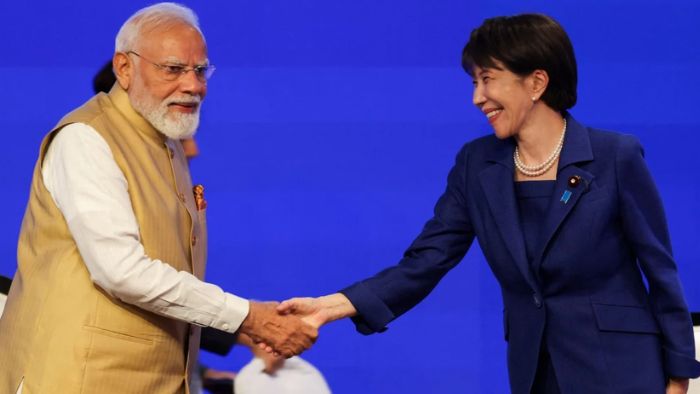
The pact to equip Indian vessels with radar-evading antennas comes as China expands its own naval cooperation with Pakistan
The project involves fitting Indian warships with Japan’s Unified Complex Radio Antenna (Unicorn) system, which lowers a vessel’s radar profile by combining multiple antennas into a single, compact structure and reducing the exposed surfaces that reflect radar signals.
The naval antenna project would “open a new chapter in our defence technology partnership”, Modi said. “Going forward, we will jointly develop defence technologies that will strengthen regional peace, maritime security and a rules-based order.”
Analysts say the collaboration reflects growing strategic trust as both countries seek closer security cooperation and less reliance on outside powers.
It also shows how far defence ties between India and Japan have progressed, after years of friction over technology transfers rooted in Japan’s strict, decades-old pacifist policies.
The agreement demonstrated “a high degree of strategic trust, one that allows for the ambition to synergise mutual defence-industrial production processes,” said Dattesh Parulekar, an assistant professor of international relations and strategic studies at Goa University in India.
The deal comes as both nations are pursuing military modernisation programmes and developing home-grown defence solutions, driven partly by shifting geopolitical alliances and mixed signals from Washington.
Parulekar said the agreement was not just about strengthening bilateral cooperation but also reflected how Tokyo and Delhi viewed “a capricious Washington, with misgivings over its credence to pursue an unflinching front”.
“Japan and India are subtly conveying that, while the US remains a significant actor in the Indo-Pacific, it need not be an indispensable partner in shaping an intrinsically derived secure, stable and resilient maritime axis,” he said.
Analysts describe Washington’s approach to Indo-Pacific security under the Quad as alternating between deep institutional commitment and strategic ambivalence.
While the US has used the grouping to counterbalance China, shifting domestic priorities and competing global crises have repeatedly raised doubts among partners about its reliability.
Srinivasan Balakrishnan, director of strategic engagements and partnerships at the Delhi-based Indic Researchers Forum, said the transfer of Japanese “ninja tech” that dramatically reduced a warship’s radar signature would strengthen the Indian navy’s capabilities.
“This breakthrough paves the way for deeper defence industrial integration, potentially extending to co-production of advanced platforms like Japan’s Mogami-class stealth frigates in Indian shipyards,” he said, adding that the deal opened the door to further technology transfers.
Balakrishnan said future collaboration could extend to next-generation sensors, AI-driven combat systems, submarine technology and missile integration, building on the Unicorn project’s success.
“In an era of heightened maritime tensions, such collaboration with a trusted Quad partner like Japan bolsters regional stability and deters aggressive posturing, underscoring India’s growing role as a key security provider,” he said.
Japan has reportedly offered India a propulsion technology partnership to power its indigenous fifth-generation fighter programme, though it is unclear whether Delhi has taken any steps to pursue a deal.
He added that further collaboration was likely in the “no less critical realm” of maritime surveillance and reconnaissance, as well as joint patrolling of exclusive economic zones.
The two countries have a multibillion-dollar agreement to jointly build eight advanced Hangor-class submarines, capable of remaining submerged for extended periods. Four are reportedly under construction at Karachi Shipyard and Engineering Works under a broad technology transfer arrangement with China.
Although diplomatic ties between India and China have improved since a 2020 border clash, India-Pakistan relations remain strained following last year’s brief aerial conflict.
It also comes as Japan-China relations are in the doldrums, at one of their lowest points since diplomatic normalisation in 1972.
“It’s only plausible for Delhi to seek calibrated counteracting cooperation with strategically aligned partners in pursuance of productive diversification,” Parulekar said. (South China Morning Post)