

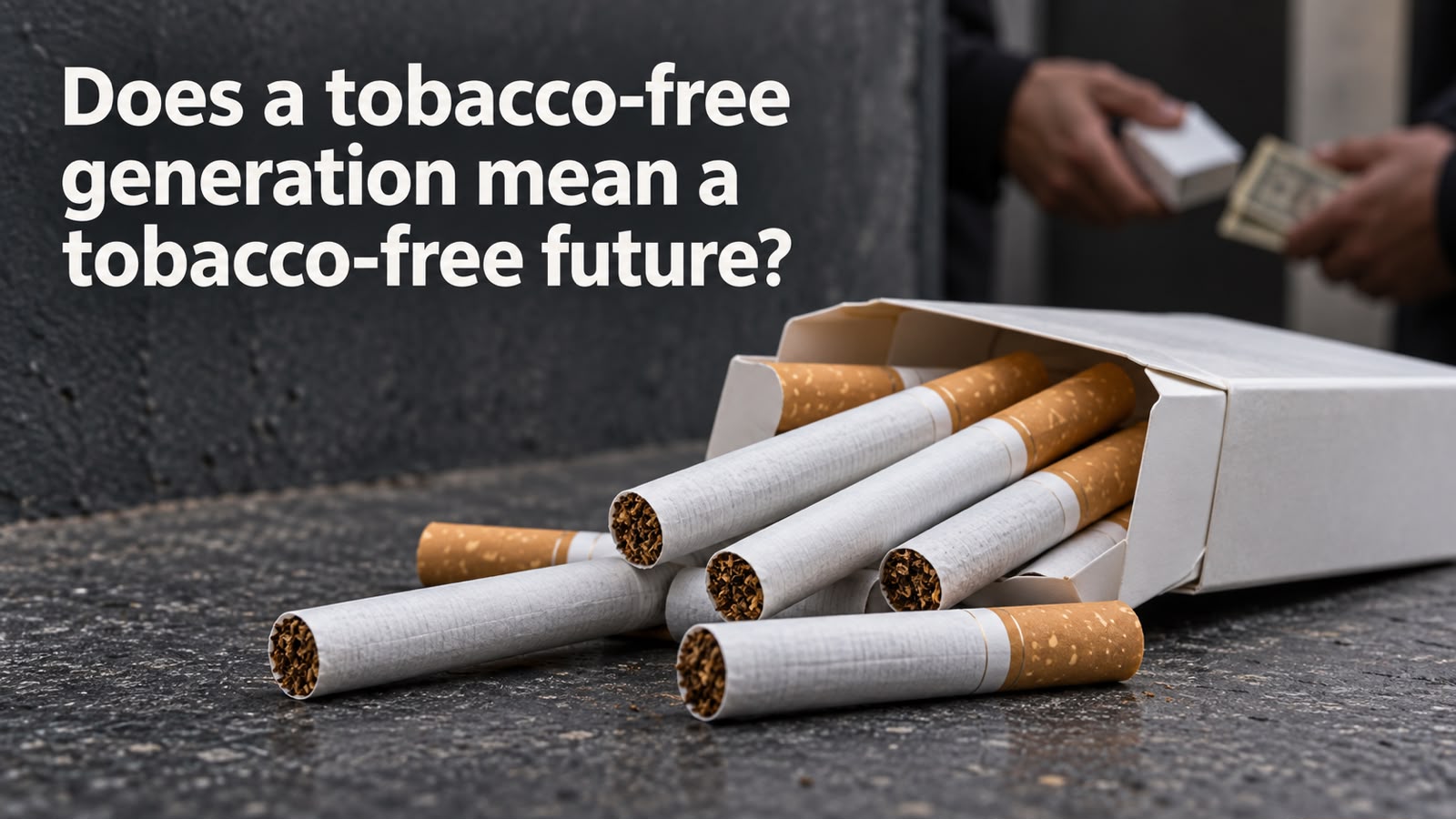
Sri Lanka is, depending on one’s perspective, either preparing to take a historic step toward a tobacco-free future, or preparing to gift a substantial and permanent revenue stream to criminal networks. The National Authority on Tobacco and Alcohol (‘NATA’) has recently launched a strategic plan to reduce the country’s smoking rate, currently at 10%, ahead of the proposed Tobacco-Free Generation programme. Notably, NATA’s Chairman, Dr. Ananda Rathnayaka, has himself acknowledged that eradicating tobacco completely is practically difficult, and that the programme cannot achieve this alone. What has received rather less attention is the mechanism being proposed to achieve a tobacco-free generation.
The proposal, , recommends that tobacco sales be permanently banned for everyone born after 2010. The health case for reducing smoking is undeniable, and nobody with a serious interest in public policy is arguing otherwise. The question is not whether to act. It is whether this particular action would reduce the smoking rate — or simply relocate the cigarette market to operators who are under no obligation to abide by any rules at all.
The global experiment nobody has completed
Proponents of a Generational Sales Ban (‘GSB’) will point to New Zealand, the United Kingdom, and the Maldives as proof that the international community is moving in this direction. They are correct. What tends to be omitted is what followed. New Zealand repealed its ban before it came into force — the incoming government citing illicit market risks as a central justification. Malaysia removed its GSB provision before its tobacco control bill even passed parliament, after the Attorney General’s chambers flagged serious constitutional concerns around equality before the law. The United Kingdom, the most recent jurisdiction to legislate, is already facing judicial review proceedings lodged in April 2026, which argue that the Act creates unlawful differential treatment of citizens based solely on their date of birth and permanently destroys a lawful customer base without compensation. As for the Maldives, its GSB will produce no observable effect until 2028 at the earliest, given that the minimum purchase age is already 21.
No country has yet demonstrated that GSB works. The most that can honestly be said is that some have attempted it and have either had it repealed, dropped before implementation, or are currently before the courts.
What bans actually produce
The harder evidence comes not from countries debating the policy, but from countries that have lived it. Bhutan gives us, what the internet refers to as the ‘forbidden fruit’ paradigm. The Bhutanese government enacted a near-total tobacco sales ban in 2004, with every cultural, religious, and governance advantage that a country could bring to such an experiment. Smuggling from India filled the gap immediately – in fact, it started doing better than the pre-existing legitimate market. The Bhutanese ban can in fact take credit for increasing tobacco consumption in the country, hence the ‘forbidden fruit’ comparison. Bhutan legalised domestic tobacco sales again in 2021, after seventeen years of an experiment that achieved the opposite of its stated aim among the very age group it was most concerned about.
South Africa’s experience during its COVID-related cigarette sales ban in 2020 is the sharpest data point available. Research found that 91% of smokers who did not quit continued to buy — through illegal channels. Within weeks of the ban commencing, every cigarette sold in South Africa was passing through criminal hands. The only lasting effect from this redacted-ban is a previously legitimate, tax paying, regulation abiding clientele was introduced to and built a permanent dependency on the illicit market. Even after the government removed the ban, they were not able to bring back the smokers they had lost to the illicit market. Many GSB advocates talk about tobacco consumption as gateways to more lethal substances, but not enough people talk about how GSBs are gateways to illicit markets – and the thing about gateways is that once you go through it, it’s very hard to comeback.
Keeping that in mind, policy makers should be conscious that bans do not eliminate demand for cigarettes. They transfer it into markets where there is no age verification, no product safety testing, no health warning, and no obligation to anyone, and it is not something that you can ‘try and see’ and ‘revert if it does not work.’ As you can see from the South African experience, the lasting effects are sometimes irreversible.
Why Sri Lanka is especially exposed
This is not an abstract concern. Even before any generational ban is in place, illicit cigarettes already account for an estimated 12% of Sri Lanka’s total smoked tobacco market (Ceylon Tobacco Company PLC 2024 results, as reported by the Daily Mirror, 28 April 2025). That figure reflects, among other things, (1) the fact that Sri Lanka’s cigarette prices rank among the highest in the world relative to purchasing power — making it a natural magnet for illicit trade, and (2) authorities are already struggling to eradicate the illicit market.
A GSB layered onto this existing dynamic would not introduce a new deterrent. It would create a new, permanent, and expanding market. The retailer compliance challenge alone is formidable: unlike a standard age check, a GSB would require every point-of-sale to determine not just whether a customer is an adult, but which cohort of adult they are. Illegal sellers would face none of that burden, and would benefit directly as compliant retailers exit the market or make errors.
There is also a constitutional dimension that deserves more than a footnote. Sri Lanka’s Constitution guarantees equality before the law. Permanently denying one cohort of adults access to a product that remains legal for their contemporaries raises questions of differential treatment serious enough to have led Malaysia’s Attorney General to find a comparable provision unconstitutional — and to have prompted formal legal challenge in the United Kingdom.
The tobacco-free generation that Sri Lanka’s policymakers are describing is a worthy goal. The policy being proposed to achieve it would, on the evidence of every jurisdiction that has attempted prohibition, most likely hand the cigarette market to criminal networks, erode excise revenues the state depends on, eliminate the age-verification safeguards, and raise constitutional questions that two other jurisdictions are already in court to answer.
Even if the legislature passes a bill that introduces a GSB, it is more than likely to be challenged and ultimately defeated in court. Sri Lanka’s ambition of a tobacco-free generation is worth holding on to, but ambition is not a substitute for a workable mechanism. The country’s time and resources would be far better spent backing the strategic plan NATA has already launched — tightening enforcement against illicit trade, upholding existing age limits, and helping current smokers to quit — than on a ban that is more likely to end up in court than to reduce smoking. The ambition is right. The evidence says the policy is not.