

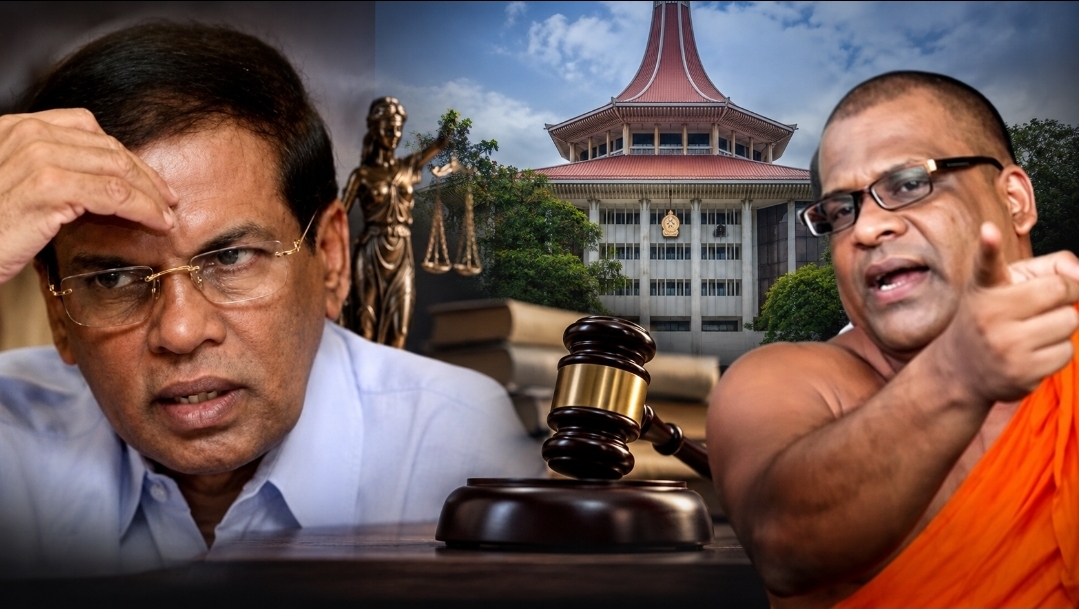
The Supreme Court has ruled that the presidential pardon granted to Ven. Galagoda Aththe Gnanasara Thero by former President Maithripala Sirisena was arbitrary and unlawful, finding that the former President had effectively approved a recommendation without demonstrating that he independently considered the relevant material before exercising his constitutional power.
In a unanimous judgment delivered Thursday, the three-judge Supreme Court bench comprising Justices Janak De Silva, Dr. Sobhitha Rajakaruna and Sampath B. Abayakoon declared the 2019 pardon null and void.
The court found that although Article 34 of the Constitution gives the President discretion to grant pardons, presidential power is held in trust on behalf of the people and remains subject to constitutional limits and judicial review.
A key issue identified by the court was the manner in which the decision to pardon Gnanasara Thero was made.
The court examined a minute prepared by the Additional Secretary (Legal) recommending a full pardon. Justice Janak De Silva observed that while the document dealt with legal issues surrounding the pardon, it did not disclose any reason as to why Sirisena should have considered granting a pardon to Gnanasara Thero in the first place.
Despite this, Sirisena had merely approved the recommendation to grant the pardon, the judgment said.
The court also raised questions over whether relevant representations and material had actually been considered by the former President before making the decision.
Among the matters raised by the court were whether Sirisena had been aware of representations opposing the pardon before making his decision and what accounted for what the judgment described as a “flurry of activity” surrounding the granting of the pardon.
The court noted that Sirisena had the opportunity to address these matters in his affidavit after the relevant Presidential Secretariat files had been placed before court, but had failed to do so.
The judgment concluded that Sirisena had effectively acted on and submitted to the recommendation of the Additional Secretary (Legal), rather than properly exercising the discretion constitutionally entrusted to the President.
“For all the foregoing reasons, I hold that the pardon granted by the 1(A) Respondent to the 5th Respondent is arbitrary, in violation of the public trust and the rules of natural justice, ultra vires his powers,” Justice De Silva held.
The court found that the decision consequently violated the fundamental rights guaranteed under Article 12(1) of the Constitution and declared the pardon null and void and of no force or avail in law.
The case relates to Gnanasara Thero’s conviction for contempt of court arising from his conduct at the Homagama Magistrate’s Court in January 2016.
The Court of Appeal convicted him on four counts and imposed prison sentences of four, four, six and five years respectively, with the sentences to run concurrently. He subsequently received a presidential pardon in May 2019.
Gnanasara Thera had served around nine months of his six-year prison term when he was granted the presidential pardon in May 2019.
The fundamental rights petitions challenging the pardon were filed by the Centre for Policy Alternatives (CPA) and its Executive Director Dr. Paikiasothy Saravanamuttu, and separately by Sandhya Ekneligoda, wife of missing journalist Prageeth Ekneligoda.
What happens to Gnanasara Thero now?
The Supreme Court made an important finding on the legal effect of a presidential pardon, holding that a pardon does not alter or set aside the conviction or sentence imposed by a competent court. Instead, it only relieves the offender from the execution of the sentence to the extent specified in the pardon.
With the 2019 pardon now declared null and void, Gnanasara Thero no longer has the benefit of that pardon, while his original conviction and sentence remain legally intact.
However, the Supreme Court judgment does not specifically order his immediate arrest or return to prison, nor does it calculate how much of the original sentence remains to be served.
Any further steps concerning his custody and the execution of the sentence would therefore have to follow from the Prison authorities in light of the Supreme Court ruling.
The Supreme Court also stressed that its decision does not prevent a President from granting Gnanasara Thero another pardon.
The court said any future pardon could be granted only in accordance with the law and after due consideration of all relevant material placed before the President.
Meanwhile, the court declined to make further orders against Sirisena, noting that the record indicated he had acted on instructions provided by the Additional Secretary (Legal), which were materially erroneous in law. (Newswire)