

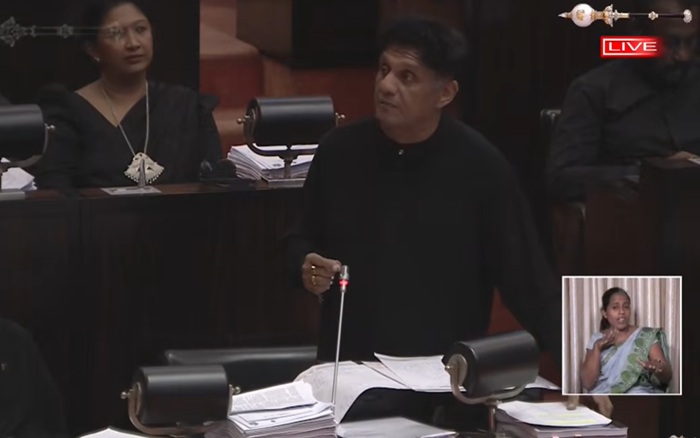
Opposition Leader Sajith Premadasa today (25) strongly criticised the proposed 22nd Amendment to the Constitution, alleging that it would undermine judicial independence, weaken the separation of powers and expand executive influence over the Judiciary.
Addressing Parliament during the debate on the proposed amendment, Premadasa called for the Bill to be withdrawn, arguing that it would damage public confidence in judges and the judicial system.
The 22nd Amendment proposes changes to the retirement ages of superior court judges, including raising the retirement age of Supreme Court judges from 65 to 67 and Court of Appeal judges from 63 to 65. Parliament is debating the Bill for a second day today, with a vote scheduled for 7 pm.
Premadasa argued that the proposed changes would weaken the system of checks and balances and the separation of powers between the executive, legislature and Judiciary. He claimed the amendment would ultimately place greater pressure on the Judiciary and erode the confidence of Sri Lanka’s citizens in the courts.
Drawing a comparison with Hans Christian Andersen’s The Emperor’s New Clothes, Premadasa accused the government of portraying the amendment as a measure intended to strengthen democracy when, in his view, its consequences would be the opposite.
The Opposition Leader also traced Sri Lanka’s recent history of constitutional amendments, referring to the 17th, 18th, 19th, 20th and 21st Amendments and the repeated expansion and restriction of presidential powers.
He criticised politicians who had supported several of these changes over the years, while arguing that constitutional reforms should strengthen rather than weaken institutional safeguards.
Premadasa also referred to controversies surrounding former Chief Justice Shirani Bandaranayake and subsequent disputes involving the Judiciary, accusing political actors of adopting inconsistent positions on judicial independence.
He maintained that the Samagi Jana Balawegaya (SJB) had stood in defence of judicial independence and said the party would continue to oppose the proposed amendment.
Premadasa further questioned the government’s position on whether the 22nd Amendment should be subjected to a referendum.
However, the Supreme Court has determined that the provisions of the 22nd Amendment Bill do not require approval at a referendum under Article 83 of the Constitution. The Court also directed changes to the wording of Clause 2 and determined that a proposed six-year term limit would not apply to the person serving as Chief Justice when the legislation comes into operation.
Premadasa also claimed that several legal organisations had raised objections to the proposed changes and argued that relevant stakeholders had not been adequately consulted.
Referring to the government’s election manifesto, he questioned why the administration was proceeding with the amendment while having previously pledged to abolish the executive presidency.
Premadasa also cited philosopher John Locke’s statement that “where law ends, tyranny begins,” while accusing the government of pursuing constitutional changes that, in his view, could concentrate political power.
He further alleged that the government was attempting to extend political control across state and public institutions and accused it of seeking to establish a system dominated by a single party.
The government, however, has rejected allegations that the 22nd Amendment is intended to establish authoritarian control. Government representatives have argued that the changes form part of broader judicial reforms aimed at addressing delays in the court system.
Concluding his speech, Premadasa said governance should remain “of the people, by the people and for the people,” and called for the proposed amendment to be withdrawn. (Newswire)