

By Newswire Editorial
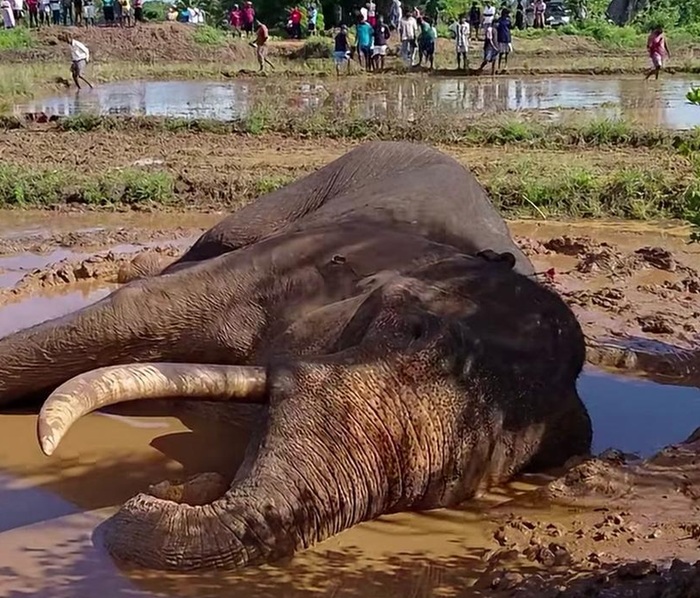
The death of elephant Kawanthissa was caused by intestinal twisting, associated septic shock and subsequent multiple organ complications, according to an interim post-mortem report submitted to the Galgamuwa Magistrate’s Court.
According to a report by the Lankadeepa newspaper, Galgamuwa Magistrate Ravindra Ranjan Bandara revealed the findings when the case relating to Kawanthissa’s death was taken up for hearing yesterday (18).
The Magistrate also rejected a request to conduct further post-mortem examinations through an international panel of specialist veterinarians, amid concerns raised by several parties over the circumstances surrounding the elephant’s death.
The interim post-mortem report was submitted by Professor R.R.M.K.K. Wijesundara of the Faculty of Veterinary Medicine and Animal Science at the University of Peradeniya, who conducted the examination.
According to the report, three chronic wounds were observed around Kawanthissa’s right leg, although no pellets or bullet fragments were found inside the wounds.
However, three pellets were discovered in the elephant’s right abdominal and chest walls during the examination. The report indicated that these pellets had not caused damage to any internal organs or bones.
The Magistrate observed that the post-mortem findings raised questions requiring further consideration.
Meanwhile, the court rejected requests made by President’s Counsel Upul Jayasuriya and Attorneys-at-Law Rohitha Rajakaruna and Balakrishnan Priyanga, representing intervening parties, to transfer investigations into Kawanthissa’s death to the Department of Wildlife Conservation and appoint an international veterinary panel to conduct further examinations.
Presenting submissions on behalf of wildlife photographer Pathum Bandara, President’s Counsel Upul Jayasuriya alleged that the Director General of Wildlife Conservation should be held responsible for Kawanthissa’s death.
He claimed that Rs. 1 billion allocated for elephant conservation in the previous Budget had not been utilised and accused wildlife authorities of neglecting their statutory and administrative responsibilities.
Jayasuriya further questioned whether Kawanthissa had received adequate follow-up care and supervision after undergoing veterinary treatment.
He said serious concerns remained over the elephant’s death, particularly as Kawanthissa had reportedly shown signs of recovery following treatment.
Attorney-at-Law Rohitha Rajakaruna also raised questions about the circumstances in which the elephant sustained gunshot injuries, arguing that injuries to the lower abdomen could have occurred while the animal was lying on the ground.
He called for the Criminal Investigation Department (CID) to take custody of firearms issued to wildlife officers assigned to Kawanthissa and investigate whether the officers and veterinarians had properly discharged their duties.
Responding to the allegations, Migalewa Wildlife Range Officer W.M.S.S. Weerakoon maintained that the Department of Wildlife Conservation had made every possible effort to protect Kawanthissa and provide the necessary medical treatment.
He rejected allegations of negligence against wildlife officials, describing them as baseless. (Newswire)