

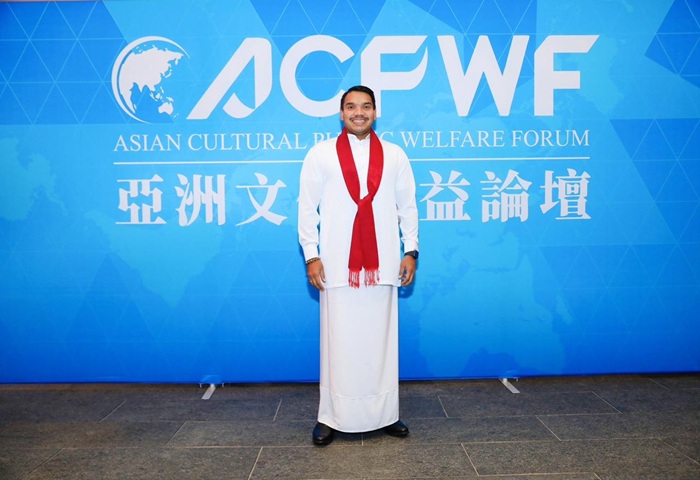
Sri Lanka Podujana Peramuna (SLPP) MP Namal Rajapaksa addressed the 2026 Asian Cultural Public Welfare Forum in Hong Kong on Friday (15), urging Asian nations to pursue modernization without losing cultural identity.
Rajapaksa highlighted Asia’s growing role in the global economy, projected to contribute 60% of global GDP growth by 2030, and posed critical questions about whether modernization would erode values, weaken identity, or harm nature.
Drawing on Sri Lanka’s civilizational heritage, he emphasized the ancient model of sustainability rooted in the “Tank, Stupa, Village, and Temple” system, and praised his father, former President Mahinda Rajapaksa, for translating that balance into modern policy.
“Mindful action is the way to endure. Carelessness is the road to failure,” he quoted from the Dhammapada, stressing that leaders must protect irreplaceable traditions and ecosystems while embracing innovation.
Rajapaksa underscored the importance of “Public Welfare Innovation” through technology such as AI, telemedicine, and renewable energy, but warned that technology without morality risks inequality and division.
He called for Asia to lead not only economically but also morally and culturally, noting that the strength of a civilization is measured by the dignity afforded to its people and the legacy left for future generations.
Full statement by SLPP MP Namal Rajapaksa;
It is a privilege to join you today at the 2026 Asian Cultural Public Welfare Forum. I thank the organizers for bringing us together in Hong Kong not just to discuss growth or technology, but to ask how civilizations can work together to create societies that are guided by values. Today, Asia stands at a defining moment. The global balance is shifting eastward.
By 2030, our continent is projected to be the single most influential driver of the global economy contributing approximately 60% of all global GDP growth. But as we rise, a simple question remains: What kind of civilization will we become? Will modernization weaken our identity? Will technology serve humanity or replace it? Will economic ambition protect nature or destroy it? They are civilizational questions.
I come from Sri Lanka. A nation known as the Pearl of the Indian Ocean. Not only for our beauty or our location, but because we stand as an ancient civilizational heart with twenty-five centuries of recorded history. Our greatest achievements came when development worked in harmony with civilization.
Two thousand years ago, our kings built massive irrigation systems and reservoirs. They were not built for prestige. They were built for Public Welfare. To ensure water security. Food security. Stability. Our ancestors understood a truth that the modern world sometimes forgets: Sustainability is our civilizational inheritance.
In Sri Lanka, we call this the four-fold wisdom: “වැවයි, දාගැබයි, ගමයි, පන්සලයි” The Tank. The Stupa. The Village. The Temple. The Tank represented shared resources. The Village represented shared lives. The Stupa represented shared values. And the Temple represented shared knowledge. They were not separate institutions. They were one system. Infrastructure created belonging. Belonging created resilience. This remains our North Star.
Leaders, such as my father, Mahinda Rajapaksa translated this ancient balance into modern policy He was a visionary leader who understood that a nation must look to the future without forgetting its past. He is the leader who transformed the Sri Lankan skyline building the ports, the highways, and the modern cities that connected us to the global economy. But even as he built the skyline, he never lost sight of the ground. He championed a model where village empowerment and social welfare are a single, unified mission for the nation. He proved that modernization does not have to come at the cost of identity.
Today, Asia faces a different world. Climate change. Digital inequality. Millions of young people demand opportunity. We cannot reject modernization. But we must pursue development with balance. In the Dhammapada, it is said, අප්පමාදෝ අමතපදං, පමාදෝ මච්චුනෝ පදං In its simplest sense, this means Mindful action is the way to endure. Carelessness is the road to failure In leadership, this means we must act with total awareness We must have the courage to protect what is irreplaceable.
In Sri Lanka, Sri Pada—Adam’s Peak—is one such place. For centuries, Buddhists, Hindus, Christians, and Muslims have climbed the mountain as an act of faith. It is a sacred site and a fragile ecosystem. As leaders, we must ask: How do we grow without losing our soul? Not every forest should become infrastructure. Not every sacred site should be transformed for convenience.
We must embrace change But only when that change aligns with our values and our traditions. This is why Public Welfare Innovation is vital. Technology is now a strategic domain. AI. Telemedicine. Renewable energy. When a child in a rural village accesses education online, that is technology for good. When digital healthcare reaches remote communities, that is welfare innovation. But technology without morality creates inequality and division.
This is where Asian civilizations must contribute to the modern world. We teach balance. Between ambition and responsibility. Between innovation and humanity. One of the greatest risks today is that societies become materially advanced but emotionally disconnected. Connected digitally, but isolated socially. Culture is the cure. Culture preserves values. It gives our youth identity in a rapidly changing world. My generation will inherit enormous pressure. We must manage AI, climate change, and geopolitics.
Therefore, young leadership in Asia must think not only about elections, but about generations. We have an opportunity to create an Asian development model where modernization does not destroy heritage, where growth includes public welfare, and where civilizations connect through cooperation. For centuries, trade routes and spiritual traditions connected India, Sri Lanka, China, and the Middle East. Today, that spirit must return.
The challenges we face climate change, economic instability do not stop at borders. Asia must cooperate civilizationally. This will determine whether Asia merely grows or truly leads. Ultimately, the strength of a civilization is not measured by military power. It is measured by the quality of life of its people. By the dignity we afford the vulnerable. And by the world we leave for our children. That is the responsibility before us. Asia is capable of more than economic leadership. We are ready for moral, cultural, and civilizational leadership in the century ahead. (Newswire)