

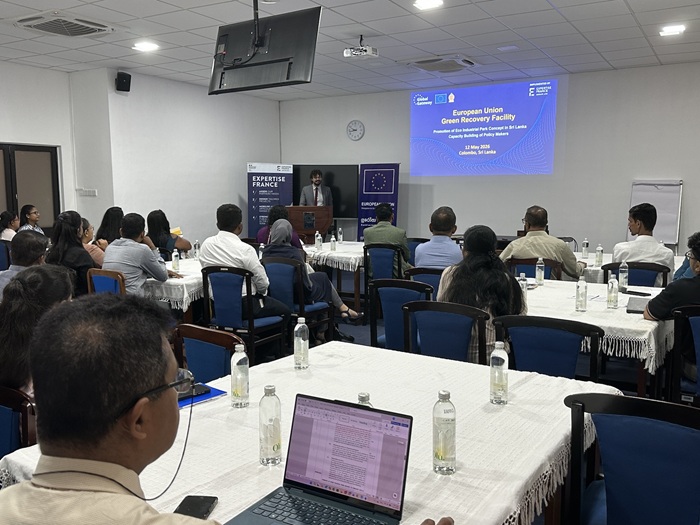
A large-scale capacity-building programme aimed at promoting the Eco-Industrial Park (EIP) concept in Sri Lanka officially commenced in April 2026, targeting more than 1,000 stakeholders across the country’s industrial sector, the European Union (EU) said.
According to a statement from the EU, the capacity-building programme is being conducted by the EU-funded Green Recovery Facility project, implemented by Expertise France, in collaboration with the National Cleaner Production Centre (NCPC), Sri Lanka and Adelphi (adelphi.de), a German consultancy firm.
The newly launched capacity-building programme brings together a broad group of stakeholders, including around 25 policymakers, 32 industrial park operators, 475 tenant industries, and 640 members from neighbouring communities, ensuring an inclusive approach to strengthening industrial practices in Sri Lanka.
Sri Lanka’s industrial sector comprises approximately 75 industrial parks and more than 1,200 industries employing over 126,000 people. As the country advances its sustainable development agenda, many industrial zones and enterprises are working to address challenges related to environmental management, resource efficiency and ageing infrastructure to enhance their competitiveness and long-term resilience.
The programme was developed based on findings from pre-assessment surveys and extensive stakeholder consultations, ensuring that the training content responds directly to the practical needs, priorities and capacity gaps identified among different stakeholder groups.
The capacity-building programme is being delivered through a series of engagements, including two virtual sessions, one in-person workshop, and follow-up training activities. The virtual sessions, conducted in April, introduced key concepts and frameworks, while the upcoming in-person sessions in May to July are expected to focus on practical application and peer learning.
Training sessions cover key areas such as policy and regulatory frameworks, green financing and investment strategies, environmental management and compliance, industrial symbiosis, and stakeholder engagement. The in-person workshops will include interactive discussions, real-case exercises, and experience sharing, enabling participants to identify solutions that can be implemented within their own industrial parks and institutions.
The activity aims to strengthen policy-level understanding, enhance the operational capacity of industrial park operators, support industries in adopting more resource-efficient practices, and encourage improved coordination with neighbouring communities.
By building capacity across these stakeholder groups, the initiative is expected to support the gradual transformation of industrial parks into more efficient, environmentally responsible, and economically competitive zones, contributing to Sri Lanka’s broader green development agenda.
Highlighting the role of eco-industrial parks in supporting sustainable industrial growth, Dr Johann Hesse, Head of Cooperation at the Delegation of the European Union to Sri Lanka and the Maldives, noted, “Sri Lanka’s industrial sector can drive a greener, more resilient recovery, especially in export-oriented segments. EU experience with eco-industrial parks shows that linking parks to innovation, cleaner technologies and markets is key to attracting investment and scaling circular economy practices, and that the strongest results come when companies choose to work together voluntarily rather than through top-down instruction. By engaging government, park operators, tenant industries and neighbouring communities, this programme helps create the conditions for competitive, low-carbon industrial growth.” (Newswire)