

- No Crime Will Be Allowed to Be Buried in the Sands of Time
- Criminals Will Be Brought Properly Before the Law
- The Present Government Is Fulfilling the Public Expectation of Bringing Corrupt and Fraudulent Individuals to Justice
- In Keeping with the Mandate We Received, We Will Transform the State into a Civilised and Law-Abiding One
- The Prevention of Terrorism Act Will Be Repealed This Year
- Today, the Country Has Embarked on a Long-Term Path of Stability
The President emphasised that bringing to justice those who stole public property through fraud and corruption had long been an expectation of the people of this country and that the present Government is one that is fulfilling that public expectation. The President further stressed that no crime would be allowed to be buried in the sands of time and that the Government would discharge its responsibility to bring offenders properly before the law.
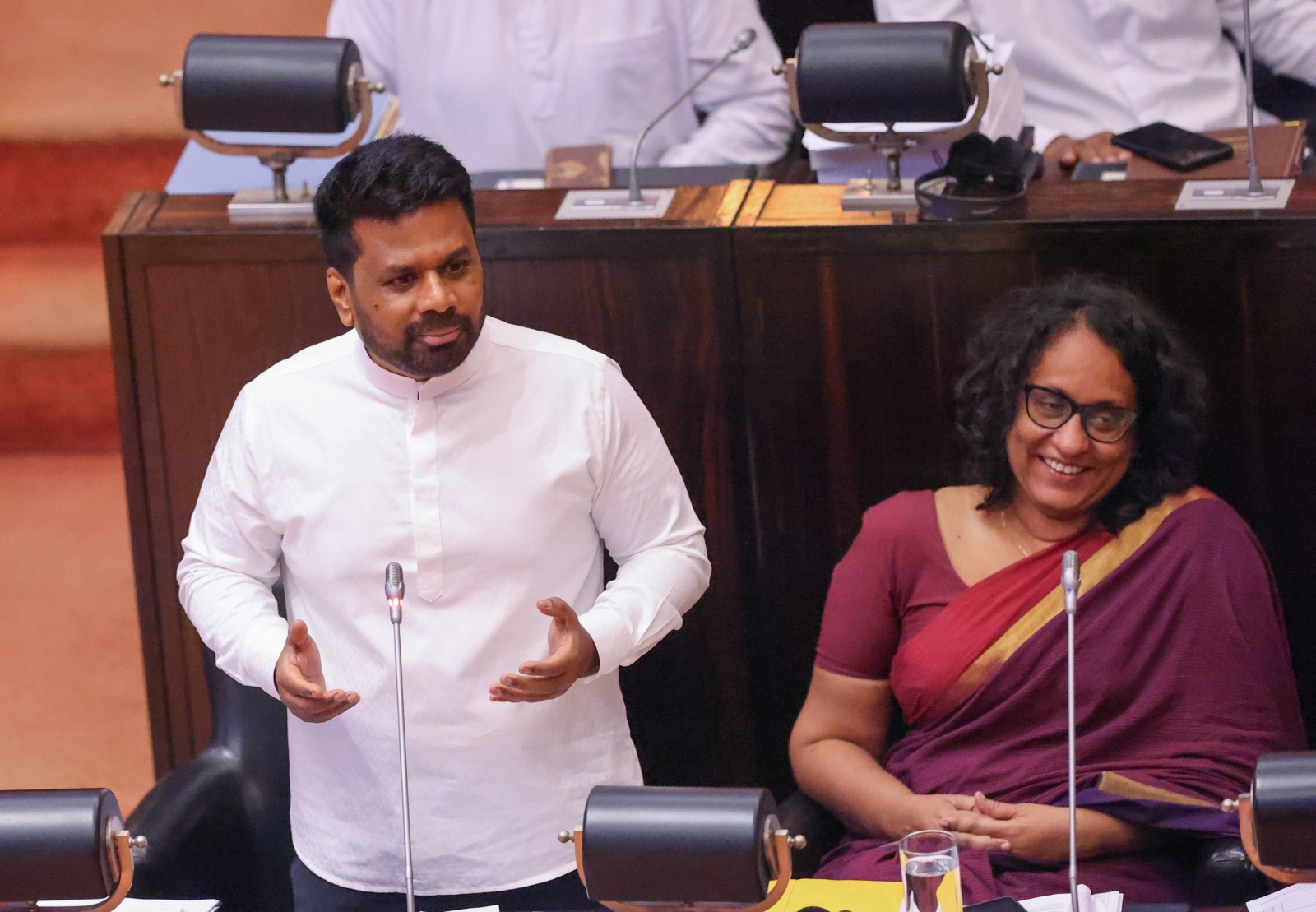
The President made these remarks while participating in the Adjournment Debate on Combating the Drug Menace in Parliament this morning (25).
Pointing out that the essence of the mandate given to the present Government by the people is the creation of a civilised state, the President stated that no personal vendettas would be pursued against anyone. He noted that the Government is committed to ensuring that everyone, from the President down to the lowest level of political leadership and from the Secretary to the President to the most junior public official, becomes a stakeholder in building a civilised state.
The President also stated that the Government has already taken a number of strong measures to suppress drug trafficking and the armed criminal gangs associated with it, adding that the country has now embarked on a path of long-term stability.
Following is the full speech delivered by President Anura Kumara Dissanayake;
I am very pleased to have the opportunity to present a few observations on the motion before Parliament today concerning the eradication of the drug menace and the suppression of organised crime.
The scourge of dangerous drugs and organised criminal gangs has grown over a long period in our country, instilling fear in society and causing immense social destruction. Therefore, it is the responsibility and duty of all of us to contribute towards eradicating this drug menace and combating organised crime.
We do not, under any circumstances, believe that the emergence and growth of drug trafficking and organised criminal gangs occurred in isolation. There are clearly established networks that sustain them. Therefore, if we are to suppress these criminal activities, we must address the entire ecosystem surrounding them. This includes organised criminal gangs, drug traffickers, corruption that had spread across State institutions and political authority, the criminal elements that had infiltrated the State, organisations that operated to serve political interests and the political connections that enabled them. These problems can only be resolved by dismantling all of these structures. That is why we have now taken a firm decision that they must all be eradicated.
I am aware that there is a group of individuals who have shouldered this responsibility with great commitment. Unfortunately, that very group has now become the principal target of the Opposition. Corruption, organised criminal gangs, drug traffickers and criminal activities carried out through the machinery of the State must all be suppressed. The necessary laws have been enacted and institutions exist to address them. However, institutions alone are not sufficient. What is required is a State machinery led by committed public officials who can provide decisive leadership and successfully defeat these forces. Those who are carrying out this task have today become the enemies of the Opposition.
In this effort, the Director of the Criminal Investigation Department, Deputy Inspector General of Police Shani Abeysekara, has played an important role. Today, he is regarded as an enemy by the Opposition. Likewise, the Director General of the Commission to Investigate Allegations of Bribery or Corruption, Ranga Dissanayake, has made a significant contribution, and he too has become an enemy of the Opposition. The Secretary to the Ministry of Public Security, Ravi Seneviratne, Minister Ananda Wijepala, and Dileepa Peiris of the Attorney General’s Department have all made substantial contributions, and they too have been branded as opponents by the Opposition. The judiciary has also played a major role in this process, and today even the courts have become targets of criticism from the Opposition.
Why is this so? Because the establishment of justice, fairness and a civilised society has become intolerable to certain sections of the Opposition. They can no longer tolerate democracy or good governance. If crimes have been committed from within the State while enjoying State patronage, should those crimes not be exposed? Is exposing such wrongdoing an act of betraying the country? Is it treason? Certainly not. It is, rather, an effort to build a civilised nation.
We must transform our State into a civilised one. Everyone, from the President down to the lowest level of political leadership and from the Secretary to the President to the most junior public official, must become stakeholders in a civilised State.
We hold our armed forces and intelligence services in the highest regard and with deep appreciation. Whenever our military and intelligence personnel, in carrying out their duties to safeguard national security and protect the people, face hardship or injustice, we will stand by them. If they have acted, both domestically and internationally, in defence of the State and the safety of the nation and its citizens, we are duty-bound to protect and honour them under all circumstances. We will fulfil that responsibility.
However, I must also say that if a small group within the military or intelligence services has acted to serve the interests of a particular family or a particular political camp, rather than the interests of the State, our Government will not hesitate to ensure that appropriate punishment is meted out.
We owe this to our armed forces, to the creation of a civilised State and to the protection of our people.
How did the assassination of Lasantha Wickrematunge take place? It was not an ordinary dispute between private citizens. A journalist critical of the Government was murdered and reports indicated that intelligence operatives had been involved. Should that be concealed? Keith Noyahr was abducted and assaulted and reports suggested that he had been detained in a military safe house. Upali Tennakoon was attacked. Poddala Jayantha was attacked. Namal was attacked. These were not ordinary civil disputes. They were crimes committed to preserve the power of a family and a political faction. The murder of Thajudeen and the Easter Sunday attacks are no different. That is not all. The Sirasa premises were set on fire, the Irudina office was torched and Siyatha was bombed. We have such a history.
Behind all these incidents were operators within a very small section of the State apparatus. Is it not necessary to reveal these truths to the country? Did we not live under the fear of white vans? Were people not abducted in unregistered white vans simply for protesting when their homes were demolished? These were not ordinary civil conflicts. A small group entrusted with protecting the State and its people was used for political purposes to carry out these barbaric murders and crimes. We are a Government that is firmly committed to ensuring that the law is enforced against such heinous acts.
We must do this in the interests of justice for the victims, to uphold the honour of the armed forces, and to safeguard the civility of the State itself. Can anyone reasonably oppose this? Only criminals, and those who benefited from or consolidated their power through such crimes, can oppose it. No ordinary citizen who values democracy, human rights and human dignity can object to these investigations.
Today, sustained attacks are being directed at Shani Abeysekara, Ranga Dissanayake, the Police and the judiciary. What crime have they committed? Their only “offence” has been to expose and investigate crimes committed against the people of this country. They are not the wrongdoers. If anyone believes that these efforts can be halted by intimidating and threatening individual officers, I assure you that we will never allow that to happen. We will stand firmly behind them. We must stand with the people, not with criminals and I invite everyone to do the same.
There was also politics associated with all this. Money was taken to prevent criminals from being killed. The proper procedure, when someone is arrested, is to produce that person before a court of law. Yet money was taken both to have people killed without being brought before the courts and, conversely, to spare them from death. These practices transcended party lines. Many believed that such matters would eventually be buried in the sands of time. We will not allow that to happen.
It is the responsibility of the State to bring criminals properly before the law. They must be investigated, arrested, prosecuted through the Attorney General’s Department and, through the judicial process, subjected to the punishments prescribed by law.
However, there was also a history of people being arrested and subsequently killed. There was a history of ransom being demanded in exchange for sparing individuals from death. The secrets surrounding the group arrested this morning will come to light shortly. I do not know whether such individuals still remain within your parties. There is also a political leader who spoke to imprisoned drug traffickers on 92 occasions. Fifty-four of those calls were initiated by him, while the remainder were made to him. I do not even know whether any disciplinary inquiry was conducted within his party regarding this matter.
This political establishment has, in many ways, contributed to the growth of drug trafficking and organised crime. We are determined to put a complete end to the protection afforded to these activities by political authority. The people entrusted us with an overwhelming mandate and at the
heart of that mandate was the transformation of our State into a civilised one. Parliament must be civilised. It must listen, deliberate and record facts. Is this not the kind of Parliament the people of this country expect in the twenty-first century? Civilised governance requires direct and principled leadership. Your Members of Parliament must also uphold those standards. We must restore civility to this country. We are engaged in a struggle to bring civility back into Parliament, State institutions and every sphere of public life.
Corruption was a recurring theme on our election platforms for many years. Since 2023, advance payments amounting to nearly one billion dollars have been made through TT transfers, yet no goods have been received. Such sums cannot be moved by ordinary individuals. These transactions involve drug money, wealth accumulated through corruption and proceeds from criminal activity. We have initiated investigations into these matters.
This has been occurring for more than two years. We have now introduced regulations to prevent it. There are links with banking institutions and we have identified several bank branches involved. It is money generated through corruption that has flowed out of the country in the form of dollars. This corruption has contributed significantly to the collapse of both our economy and our social fabric. Should such activities not be investigated? We harbour no desire for personal revenge or to settle personal scores with anyone.
It has now been nearly two years since this Government came to power. If our intention had been revenge, it would have been carried out the moment we assumed office. This is not revenge. Parliament has systematically enacted stronger laws to combat corruption and bribery. Institutions have been established to conduct investigations. Some investigative bodies had become weak and ineffective and we have strengthened them. We have recruited additional personnel to the Attorney General’s Department. Court proceedings had been delayed and therefore new High Courts have been established. Our objective is to expedite this entire process so that justice can be delivered through the courts.
The people of this country have long expected those who stole public property to be punished. This expectation transcended party lines; it was a collective public demand. Our Government has therefore become one that gives life to that public expectation by ensuring that corrupt and fraudulent individuals are brought to justice.
Since assuming office, our Government has seized substantial quantities of illicit drugs and significantly strengthened enforcement operations. We have identified drug trafficking routes through airports, ports and postal services. Arrests are being made regardless of status or influence. From underworld figures to those who enjoy social respectability, individuals at every level have been involved in this trade and we are taking action against all of them without exception.
We are also making a major effort to suppress organised criminal gangs. So far, 23 individuals against whom Interpol Red Notices had been issued have been brought back to Sri Lanka from overseas. In addition, 35 others connected to various forms of drug trafficking have been arrested and repatriated.
We are fully aware that criminal activities have been orchestrated from within prisons. To address this, we have established a new prison facility at Welisara that provides prisoners with proper amenities while completely preventing external communications and transactions. We are transferring the principal offenders there and all communication networks within that facility have now been dismantled. As a result, we have significantly curtailed the ability of organised criminal gangs to direct their operations from prison.
Accordingly, our Government has already taken a series of strong and decisive measures to suppress drug trafficking and the armed criminal gangs associated with it.
We are fully committed to eradicating organised criminal gangs, the underworld networks connected to them and the drug trade linked to those networks from Sri Lanka. I assure you that we will uproot them entirely. At the same time, none of these actions will be carried out at the expense of democracy. If grievances arise within any sector, people have every right to criticise the Government. We do not want a society that lives in fear of its rulers or remains subservient to them. What we seek is a system of governance in which those in power are constantly questioned and remain accountable to the people. That is the nature of the relationship between citizens and the State in a civilised society. A society governed by fear cannot progress. People must have the freedom to question their rulers openly and independently. For that reason, our political movement has always worked to broaden every democratic space available in this country.
For many years, people struggled to secure the repeal of the Prevention of Terrorism Act. I am pleased to state that this Act will be repealed within this year. The final discussions on the matter have already been concluded and we will move swiftly to abolish it. However, we are also conscious of the threat posed by organised crimes at this moment. Therefore, we are formulating strong legislation specifically designed to combat organised criminal activity.
Under the PTA, terrorism could be interpreted in many different ways, creating an excessively broad scope for legal action. One could potentially bring charges under the Act based on wide-ranging interpretations. By contrast, the legislation we are preparing on organised crime will contain precise definitions tailored specifically to organised criminal activity. The broad and ambiguous provisions that existed under the PTA made it possible to target individuals simply because they disagreed with those in power. We are determined to eliminate such possibilities.
The definitions contained within the PTA were so expansive that almost any activity could be brought within its ambit. We are therefore introducing reforms that fully safeguard fundamental rights, freedom of expression and democratic freedoms and we intend to implement these changes very soon.
Similarly, the proposed Organised Crime Act will focus exclusively on organised criminals and will establish a clear and specific legal definition for that purpose. Parliament will, of course, have the opportunity to debate these provisions in detail. The legislation will be designed entirely around addressing organised criminal activity.
There was also extensive debate in Parliament when the Online Safety Act was introduced. We opposed that legislation. Amendments had already been proposed, yet the practice at the time was to pass a Bill in Parliament and then introduce further amendments through the Cabinet the following week. That was the political culture that prevailed. We have no intention of implementing the Online Safety Act in its present form. Instead, we are undertaking a comprehensive revision of it, and last week we secured Cabinet approval to introduce a new Bill.
These were laws that had the potential to undermine the rights of the people and we are committed to abolishing or reforming them. Furthermore, numerous protests have taken place across the country, yet no single water cannon have been used against the public during our period in office. Tear gas has not been deployed against ordinary citizens either. That is the kind of Government we represent. There was one incident involving unrest at the Matara Prison, where attempts were made to breach the prison compound. Tear gas was used only within the confines of the prison itself. But this remains the only period in Sri Lanka’s history during which tear gas has not been used against public demonstrations.
Likewise, this is a Government that has refrained from using water cannons against its citizens. We are a democratic administration. We want to build a State that empowers people. If we do not create
such a State, we know that no one else will. Citizens must be able to question those in authority. They must enjoy freedom and be granted their rights. For a country to move forward, it needs a system of governance that guarantees democratic freedoms to its people. We therefore remain deeply committed not only to democracy but also to upholding human rights and human dignity.
Consider how many journalists were threatened in the past and how many media institutions were subjected to attacks. That is no longer the reality today. Yet, even as we safeguard democracy, we also recognise that those who enjoy democratic rights have a responsibility to conduct themselves with civility.
Some political camps still struggle with this. They are not accustomed to operating freely within a democratic environment. They are used to functioning through fear and subservience. As a result, they often do not know how to express their views or conduct their struggles within a democratic framework. Can one claim to be engaging in democratic protest by going to the private residence of the Secretary to the Ministry of Finance? Any protest may be carried out in front of the Ministry of Finance or in front of Parliament, that is democratic. But going to an official’s home is an act of incivility.
These were laws that had the potential to undermine the rights of the people and we are committed to abolishing or reforming them. Furthermore, numerous protests have taken place across the country, yet no single water cannon have been used against the public during our period in office. Tear gas has not been deployed against ordinary citizens either. That is the kind of Government we represent. There was one incident involving unrest at the Matara Prison, where attempts were made to breach the prison compound. Tear gas was used only within the confines of the prison itself. But this remains the only period in Sri Lanka’s history during which tear gas has not been used against public demonstrations.
Likewise, this is a Government that has refrained from using water cannons against its citizens. We are a democratic administration. We want to build a State that empowers people. If we do not create
such a State, we know that no one else will. Citizens must be able to question those in authority. They must enjoy freedom and be granted their rights. For a country to move forward, it needs a system of governance that guarantees democratic freedoms to its people. We therefore remain deeply committed not only to democracy but also to upholding human rights and human dignity.
Consider how many journalists were threatened in the past and how many media institutions were subjected to attacks. That is no longer the reality today. Yet, even as we safeguard democracy, we also recognise that those who enjoy democratic rights have a responsibility to conduct themselves with civility.
Some political camps still struggle with this. They are not accustomed to operating freely within a democratic environment. They are used to functioning through fear and subservience. As a result, they often do not know how to express their views or conduct their struggles within a democratic framework. Can one claim to be engaging in democratic protest by going to the private residence of the Secretary to the Ministry of Finance? Any protest may be carried out in front of the Ministry of Finance or in front of Parliament, that is democratic. But going to an official’s home is an act of incivility.
There remains a very small group that does not know how to exercise freedom within a democratic society. The challenge is understanding how to preserve dignity and civility in political struggles and how to define the limits of one’s own freedoms within a democratic State.
I have no particular view on that matter. We know that whenever the Opposition attempts to seize the Mace, traditionally the Government side would also descend into the chamber. Only the other day, the Opposition did so, yet not a single Government MP left these benches and went down.
Why was that? For a long time in this country, there has been a perception that carrying away the Mace was an act of heroism by the Opposition, while preventing it from being taken was an act of heroism by the Government. But this time, that did not happen. The people no longer see carrying the Mace on one’s shoulders as a heroic act; they see it as an uncivilised one.
At some point, we must collectively embrace a more civilised political culture and I believe Parliament is the best place to begin. We know that our country has now embarked on a path of long-term stability and the measures we are taking are aimed precisely at bringing about the transformation that Sri Lanka requires.
I have also observed the considerable controversy surrounding the judiciary, particularly regarding the appointment of judges to the superior courts. I sought clarification from the Chief Justice, who provided a detailed explanation. The issue, he noted, is not simply about a single judge retiring from one court; rather, it concerns the sustainability of the entire judicial system.
Today, several Magistrates’ Courts remain closed. The Attorney General has requested the establishment of three-judge High Courts, yet there are insufficient judges available to constitute them. In some instances, judges appointed to existing three-judge benches are already overburdened with work. Consequently, there are significant vacancies in the lower courts. We must therefore proceed by filling those positions first. The Judicial Service Commission has already approved the recruitment of fifty new magistrates. To my knowledge, interviews are currently underway and thirty-three candidates have been shortlisted. I cannot say how many will ultimately be selected after the interviews, but we must bring into the system those who possess the necessary capacity and qualifications. Accordingly, decisions regarding appointments to the superior courts must be made without allowing the lower courts to collapse. We have even been compelled to close several additional Magistrates’ Courts. All of these factors must be managed carefully. The Chief Justice has provided a comprehensive explanation on these matters.
There is also a clear roadmap regarding future appointments. Therefore, I believe the vacancies in the superior courts can be filled within a relatively short period. I noticed some claims suggesting that these vacancies are being deliberately kept open as a form of leverage to influence judicial decisions. Nothing could be more insulting to our judges. We must not demean our judicial system in that manner, nor should we insult the integrity of our judges.
We are committed to ensuring that justice is properly administered and that victims receive the justice they deserve. We have absolutely no desire to control the judiciary. Nor do we seek to control the media or suppress public protests. You know very well that the media landscape in this country has always been diverse and divided. The media has every right to criticise the Government, to question it and to point out its mistakes.
If the Government acts incorrectly, the media has the right to expose those errors. At the same time, I believe the media itself will come to understand the boundaries of civil and responsible conduct. We do not intend to teach them; they will learn in due course. They must understand where society stands and how it is evolving. If the media remains trapped in outdated practices while society moves forward, it risks losing its relevance and standing within that society.
Therefore, while safeguarding democracy and firmly combating narcotics and other forms of crime, we hope to transform this country into a civilised State and a civilised society. I conclude with the expectation that all citizens will extend their support to this endeavour.