

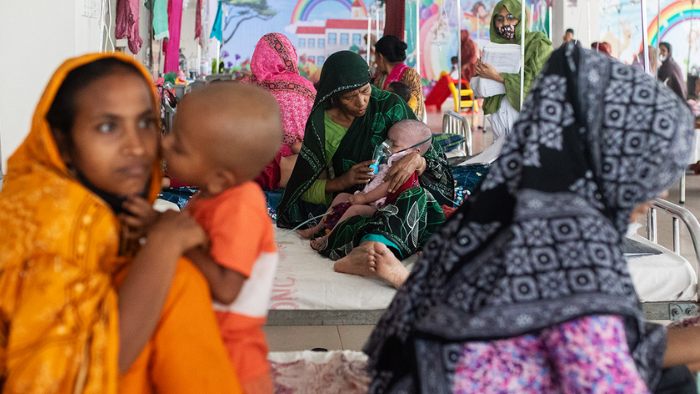
On 7 April, a woman named Konika Akter lay on the floor of Dhaka Shishu Hospital & Institute, crying and calling on God for mercy. Her husband, Mohammad Zakir, stood beside her, his face hollow with grief. Slapping his chest, he pointed to their 6-month-old daughter Ruhi, lying in a bed in a measles ward. “How can I bury the one who looks just like her?” he asked.
Ruhi’s twin sister, Risa, had died from measles earlier that day. Now, Ruhi had been transferred to the same intensive care unit bed where her sister had passed away.
Bangladesh is in the grip of an explosive measles epidemic, with more than 32,000 suspected cases and more than 250 deaths since mid-March, most of them young children. It has led to chaotic scenes in the country’s hospitals. Dhaka’s Infectious Disease Hospital filled up with children earlier this month, some struggling to breathe and others lying unnervingly still. Some were being treated on the floor because of a shortage of beds.
Measles, a disease that, a decade ago, scientists dreamed of eradicating, is making a dramatic comeback in many countries. Canada and several European countries have recently lost their “measles-free” status. The United States has reported more than 1700 cases so far this year, up from 100 or so in the early 2000s, while outbreaks continue across the Middle East and Africa. Growing vaccine hesitancy, disruptions in immunization during the COVID-19 pandemic, and wars have all contributed to the resurgence.
But in Bangladesh, a country of more than 175 million that has long taken pride in its high vaccination rates, the epidemic stems from a catastrophic breakdown in vaccine procurement following the country’s 2024 revolution. The result was nationwide vaccine shortages and plummeting immunization rates. As the disease spread, high child malnutrition and a weak health system have exacerbated the death toll. Experts say the tragedy highlights how quickly progress in public health can erode.
Bangladesh routinely administers two doses of the measles-rubella (MR) vaccine to children at 9 months and 15 months of age, supplemented by nationwide campaigns every 4 years to cover any children that were missed and reach 95% coverage, the threshold needed to prevent outbreaks. For years, UNICEF supplied the vaccines, with most of the funding provided by Gavi, the Vaccine Alliance. The government contributed as well.
The 2024 revolution disrupted that system. Bangladesh’s autocratic Prime Minister Sheikh Hasina was ousted after widespread protests in which hundreds of students were killed, giving way to an interim government led by economist and Nobel laureate Muhammad Yunus. In September 2025, Yunus’s government halted vaccine procurement through UNICEF and moved to an open tender system—a procurement process in which the government invites suppliers to bid and evaluates proposals before placing orders.
UNICEF strongly opposed the change, worrying it might disrupt the immunization system and lead to an outbreak. “It was very frustrating,” says Rana Flowers, the agency’s representative in Bangladesh, who says she repeatedly warned health officials. “For God’s sake … don’t do this,” Flowers recalls telling interim health minister Nurjahan Begum, who did not respond to questions from Science.
The tender process got mired in bureaucratic delays and the supply of vaccines dried up, leading to nationwide stockouts that hampered routine immunization. A supplemental MR immunization campaign, originally planned for 2024 but postponed to 2025 because of the political unrest, was canceled as well. In late March of this year, government figures indicated only 59% of eligible children received their measles vaccination in 2025. (The data were later removed from the government’s website.)
The outbreak began in January of this year in Rohingya refugee camps near the Myanmar border and quickly spread nationwide. It has now reached 58 of Bangladesh’s 64 districts, causing more than 21,000 hospitalizations. In a 23 April update, the World Health Organization (WHO) warned of a “considerable risk” of spread to Myanmar, where civil strife has also disrupted immunization, and India, which is vulnerable as well. WHO called the outbreak “a reversal from Bangladesh’s previous progress towards measles elimination.”
Malnutrition, which is rife in Bangladesh, is increasing the rate of severe disease and death; about 28% of children under age 5 are stunted and 10% suffer from wasting. Vitamin A deficiency also weakens children’s defenses, and the country has missed three of its biannual vitamin A distribution campaigns since 2024, says ASM Alamgir, former principal scientist at the Institute of Epidemiology, Disease Control and Research (IEDCR). And poorly funded clinics and hospitals are overwhelmed. “Beyond immunization gaps, Bangladesh’s measles crisis reflects deep structural weaknesses,” says Mohammad Mushtuq Husain, adviser at IEDCR.
The newly elected government, which took office on 17 February, is taking action. It reinstated vaccine procurement through UNICEF in April and coordinated with WHO and Gavi to secure supplies, says Ziauddin Hyder, a special assistant on health affairs to Tarique Rahman, the new prime minister. On 5 April, authorities launched an emergency vaccination campaign targeting children aged 6 months to 5 years in high-risk areas, followed by a nationwide rollout on 20 April. Vitamin A distribution will soon resume as well, Hyder says.
Given the speed at which measles is currently spreading, however, the emergency campaign is unlikely to stop the epidemic quickly, warns Be-nazir Ahmed, former director of disease control at the Directorate General of Health Services, Bangladesh. “At this rate of vaccination, the infection will not decrease right now,” he says.
Husain says the government should declare a public health emergency to highlight the severity of the crisis and spur further action. “This is already an emergency,” Husain says. “So why hesitate to officially declare a public health emergency?”
The crisis has stirred outrage and recriminations. During a Q&A session in parliament, Rahman blamed both Hasina’s government and the interim government. But in an email to Science, Hasina—who was sentenced to death for crimes against humanity in absentia and is now in exile in India—said her government prioritized vaccination and pointed out that no major measles outbreaks occurred during her 15 years in power.
Many scientists Science talked to point to the interim government, which has also come under legal scrutiny. On 12 April, Biplob Kumar Das, a Supreme Court lawyer, filed a complaint with Bangladesh’s Anti-Corruption Commission, alleging corruption and vaccine-procurement failures under the interim government. Flowers agrees that, given the dramatic fallout, the decision to change the procurement system needs to be investigated.
Sayedur Rahman, former vice chancellor of Bangladesh Medical University who was a key health adviser to the interim government, says the old procurement arrangement needed to be changed because it was based on a legal clause designed for emergencies. In an email to Science, he wrote that the interim government wanted it “shifted to a regular, rule-based system going forward” to “avoid questions about transparency or lead to perceptions of bias.”
Sayedur Rahman did not answer follow-up questions about what exactly went wrong, but acknowledged the human toll of the crisis. “The loss of children to a fully preventable disease like measles is heartbreaking,” Rahman wrote. “It is a human tragedy, and my deepest condolences go to every family that has suffered.” (science.org)