

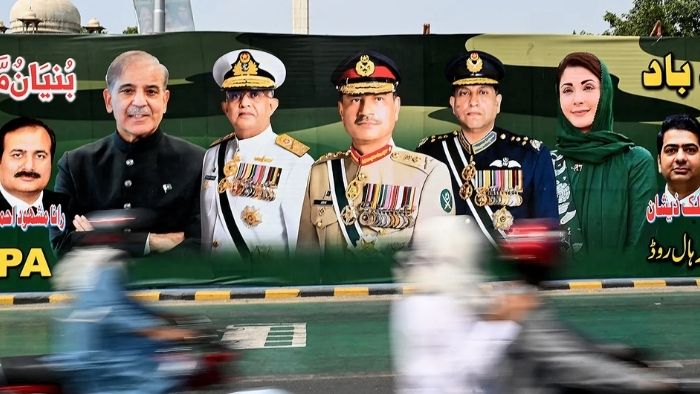
In an increasingly multipolar world, Pakistan has become more strategically relevant. Over the past three years, Pakistan’s Chief of Army Staff Asim Munir has steadily consolidated control and formalized the military’s dominant role within Pakistan’s constitutional framework. He appears to have successfully gained the trust of U.S. President Donald Trump, strengthened ties with Arab and Gulf states, leveraged these relationships to mediate between Iran and the United States, and portrayed the May 2025 conflict with India—Pakistan’s long-standing adversary—as a strategic success. This last development, in particular, appears to have bolstered the military’s domestic standing at a time when the public’s confidence in it had been under strain.
Domestically, under Munir’s command, the military—the perennial kingmaker in Pakistani politics—has entrenched its dominance through a weak and compliant civilian government. It has done so by leveraging coordination between the ruling Pakistan Muslim League–Nawaz (PML-N) and the Pakistan People’s Party (PPP) coalition, along with media regulation and censorship, internet governance, and sustained, heavy-handed repression. Within the armed forces, divisions are being managed to alleviate the risk of internal resistance, which was a concern after the 2023 arrest of Pakistan’s populist former prime minister Imran Khan.
Although Munir has successfully consolidated authority, the government appears to be gambling on international goodwill to establish popular legitimacy at home, or at least to shore up elite support and dependence. In the last month, Munir and his government have seized the opportunity to play a pivotal role in mediating between Iran and the United States, gaining praise from major stakeholders in the conflict, and building credibility and global relevance.
But can international goodwill be converted into domestic legitimacy? Can the regime’s consolidation hold, or will there be resistance at home? Will Pakistan stabilize its economy while managing internal and cross-border security? And, what happens if, in a globally volatile environment, new external challenges jeopardize the international partnerships upon which this regime depends?
Whether Munir’s power endures will depend on four interlocking tests: (i) the regime’s management of domestic political fault lines; (ii) the durability of its constitutional redesign; (iii) the military’s ability to stabilize the economy and generate growth; and (iv) Munir’s ability to sustain external partnerships.
Domestic Consolidation and Its Limits
One of the regime’s principal challenges over the past three years has been to consolidate control at home. The regime’s guiding doctrine is the “hard state” approach, which involves an uncompromising, militarized framework for internal security and political management. This approach relies on political repression and constitutional redesign to centralize the regime’s command structure and narrow the space for political dissent and mobilization.
As part of this “hard state” approach, the regime’s list of political prisoners has expanded dramatically in recent years. Imran Khan and his wife have now been incarcerated for nearly three years, and members of Khan’s Pakistan Tehreek-e-Insaf (PTI) party have been subjected to both legal and extra-legal repression.
Public gatherings and assemblies are increasingly criminalized, especially in the capital, Islamabad. The government’s strategy to quell street mobilization and blunt the PTI’s political momentum has proven largely successful, as the appetite for confrontational politics in the central province of Punjab has significantly dissipated since 2023. But Khan retains his widespread popularity, even behind bars.
Managing Dissent Through Repression
Criticism and dissent have continued in the digital sphere, despite the deployment of internet firewalls to suppress unwanted internet traffic and on the enforcement of the Pakistan Electronic Crimes Act (PECA) to criminalize online criticism of government and army officials. In a widely publicized case, the courts used PECA to sentence human rights lawyers Imaan Mazari and Hadi Ali Chatha to seventeen years in prison for social media posts condemning the state’s reliance on enforced disappearances in Balochistan. In another high-profile case, a Canadian doctoral student visiting Pakistan for academic research was charged under PECA for social media posts in a cybercrime case after being reported “missing” for at least three days.
Outside the country’s political centers, the regime contains oppositional forces through measures that show little regard for human rights or constitutional constraints. Authorities have suppressed popular social movement organizations demanding redress for the grievances of ethnic minorities in Pakistan’s peripheral regions. Leaders including Ali Wazir of the Pashtun Tahaffuz Movement—a rights-based movement advocating accountability for security operations in Pakistan’s northwest—and Mahrang Baloch, along with other Baloch activists affiliated with the Baloch Yakjehti Committee, which campaigns against enforced disappearances and for the protection of Baloch rights, have been imprisoned, punished, and silenced.
Separately, authorities have escalated the mass deportation of Afghan refugees, with Human Rights Watch reporting that more than 146,000 Afghans have been forcibly returned this year alone. These deportations continued alongside the U.S.-Iran peace talks in Islamabad, the capital city, where marginalized communities were also forcibly evicted in major anti-encroachment drives targeting long-established informal settlements. Yet, in a global era of rising illiberalism and authoritarianism, this pattern of repression has not registered sustained international attention.
Balochistan and the Limits of the Hard State
Balochistan remains the regime’s weakest link and the hard state’s soft underbelly. Over the past few years, the separatist insurgency has intensified. In January 2026, the Baloch Liberation Army (BLA), the province’s primary insurgent group, successfully penetrated urban spaces, hit hardened targets, including a high-security prison and police station, and killed both civilians and security personnel.
While government security forces have reportedly killed dozens of militants in retaliation, observers have questioned how the BLA was able to carry out coordinated assaults in what is arguably the most militarized province in Pakistan. The attacks have also prompted scrutiny over possible intelligence failures in a province where state legitimacy is contested and public support for separatist sentiment persists.
The January attack came soon after the March 2025 assault on the Jaffer Express passenger train, which resulted in significant casualties and heightened security tensions. Pakistan blamed India for the 2025 attack, and the government’s response included large-scale military operations during which human rights groups documented gross human rights violations including extrajudicial killings and enforced disappearances.
Should the regime continue with its hard state approach rather than finding ways to address local political and economic grievances essential to governing the province effectively, it risks exacerbating resentment and further destabilizing Balochistan. It is also possible that this flashpoint could become a trigger for another violent confrontation between India and Pakistan, should Islamabad continue holding India responsible for financially backing Baloch insurgent groups.
Another test for Munir is whether the uptick in violence threatens foreign assets and investments in Balochistan. Chinese projects under the China–Pakistan Economic Corridor (CPEC)—a flagship infrastructure and energy program under Beijing’s larger Belt and Road Initiative—have already been subject to repeated attacks. Continued violence could also threaten American mineral and energy investments, potentially undermining investor confidence.
This April, as Iran ceasefire negotiations took place in Islamabad, the government remained tight-lipped about an armed attack on a multinational mining exploration site in Balochistan, in which employees were abducted and killed. Given that Balochistan neighbors Iran, the attack raises questions about the continued volatility of the region and concerns about how the Iran war may spill over across the border.
Khyber Pakhtunkhwa and the TTP Challenge
In addition to Balochistan, Pakistani security forces continue to face resistance in Khyber Pakhtunkhwa (KP), where the army also appears to lack public legitimacy. Due to Pakistan’s history of patronizing the Tehreek-e-Taliban Pakistan (TTP)—a Pakistani militant organization that has targeted the state—counterinsurgency efforts in KP and the former tribal areas have not yielded lasting peace. The year 2025 was Pakistan’s deadliest in a decade, with substantial army and police losses. Decades of armed violence and instability have caused communities to distrust the state, enabling the TTP to recruit locally.
The regime’s challenge in KP will be managing local sentiment, given that a portion of the population has been more sympathetic to the Pakistani Talibanthan the armed forces. Pakistan’s troubled relationship with Taliban-ruled Afghanistan has also enabled the TTP to rely on the support of the Afghan Taliban, allowing its members to move back and forth across the border, which complicates Pakistan’s ability to target the organization. The impact of the escalation of violence between Pakistan and Afghanistan since February of this year on local attacks and the military’s standing and popularity within KP remains to be seen.
Entrenching Military Authority Through Constitutional Reform
Beyond managing dissent, the regime has sought to formalize its dominance through constitutional and legal reform. Recent amendments have reshaped both the military chain of command and the judicial architecture, reducing institutional uncertainty and limiting avenues for political challenge. Taken together, these changes represent an effort not only to consolidate authority, but to insulate it from future contestation.
Reconfiguring Civil-Military Command
Munir is the latest in a long line of Pakistani military strongmen who constitutionally entrenched their authority and immunized their regimes from accountability. The twenty-seventh constitutional amendment, passed in November 2025, created the new post of the chief of defence forces, which is to be held by the army chief. The amendment formally grants him operational command over the chiefs of the navy and air force. While the army previously exercised informal influence over these institutions, its influence has now been enshrined in law.
The lesson the military leadership has learned from history is that political uncertainty and instability are always heightened when the term of the military chief nears its end, as the chief needs an extension, which must be formally granted by the political leadership. This rare window of civilian leverage over the army chief provides civilian politicians with an opportunity to bargain for new political concessions, while also giving ambitious military officers an opportunity to aspire to the top of the security hierarchy. This dynamic is especially concerning for the current military leadership. Although Munir’s key army rival, former chief of the powerful Inter-Services Intelligence Directorate and Khan ally Faiz Hameed, has been imprisoned for misuse of authority, pro-Khan sympathies may persist within the armed forces and their social networks.
In response to this concern, parliament amended the Army Act—at the government’s behest—to extend the army chief’s tenure from three to five years and to restart the five-year term upon appointment as chief of defence forces. This effectively secured Munir’s position as the top military officer until 2030.
Finally, Munir was elevated to the previously symbolic position of field marshal after the conflict with India earlier in May 2025. The twenty-seventh constitutional amendment turned this honorary position into one with special privileges, allowing the field marshal to retain his rank and uniform and granting immunity from criminal proceedings for life.
While this restructuring will curb threats within the army for now, grievances over promotion bottlenecks could create new institutional faultlines in the future.
Judicial Restructuring and Executive Control
For consolidation to succeed, the process of constitutional entrenchment had to proceed without significant legal obstruction. Pakistan’s judiciary had played an outsized political role in recent years, but a politically ambitious judiciary had no place in the new regime. This was especially true given that, since the fall of Khan’s government in 2022, the courts had occasionally made politically consequential decisions that frustrated the regime’s consolidation and provided PTI with a modicum of political space.
Therefore, the twenty-sixth and twenty-seventh constitutional amendments significantly curtailed the autonomy of the superior judiciary and limited its capacity for independent constitutional review. The two amendments gave the governing coalition authority over appointments and promotions within the superior judiciary; opened up new vacancies that the government could quickly fill with loyalists; expanded the executive’s role in transferring, disciplining, and even removing judges; and, most significantly, established a new federal constitutional court at the helm of the judiciary—composed largely of judges appointed under executive-led selection procedures and unbound by past Supreme Court judgments or precedents.
This constitutional redesign was carried out without any parliamentary deliberation or discussion. The legislature was largely confined to rubber-stamping decisions made by the military and political leadership outside parliament. At the end of this constitutional redesign, the military leadership’s position atop the security chain of command, and the executive branch’s position atop the constitutional chain of command, have been formalized.
However, these constitutional changes have also generated dysfunction within the judicial system, frustrating the work of many judges and lawyers. It remains unclear whether this restructuring is complete, and further amendments could risk overreach, particularly if they strain the cohesion of the ruling coalition. For instance, speculated constitutional changes relating to administrative organization and fiscal distribution within Pakistan’s federal structure would be unpalatable to the PPP, a party for which provincial autonomy—granted under the eighteenth amendment—has been a major achievement. Thus, the constitutional overhaul has consolidated the regime for now but may invite future challenges of institutional dysfunction and coalition mismanagement.
Fragile Stabilization and Reform Deficits
Pakistan managed to avert critical financial catastrophes in 2025, including sovereign default and heightened inflation, thanks to the support of an International Monetary Fund program. However, the country still faces a high fiscal deficit, which means greater reliance on external financing. Heavy borrowing risks future economic instability. As journalist Khurram Husain wrote in January this year, Pakistan “had hit peak stability a year ago. That was the moment to start transitioning from stabilisation to growth, on the back of some sort of reform agenda. But no reforms came. Nothing happened. The government was content to simply proclaim success on the back of stabilisation alone, thinking its job was done.”
Analysts broadly agree that the current government has undertaken few structural economic reforms and remains unable to broaden the tax base, particularly among higher-income groups. The recent spell of moderated inflation is now under renewed fiscal pressure—driven in part by rising energy prices linked to the Iran war—given Pakistan’s heavy reliance imported fuel. This will adversely impact food, transportation, and electricity costs, and remittances generated from the Middle East. Pakistan’s economic stabilization is therefore fragile; unemployment and the cost of living remain high, a growing proportion of the population has fallen into poverty, and now, as a result of the global energy crisis, rolling blackouts have returned.
Collectively, these strains could generate public pressure on both the civilian government and its military patrons. There is growing public recognition that ultimate governing authority rests with the military leadership, particularly following the establishment of the Special Investment Facilitation Committee, the new flagship body for managing investments, which includes Field Marshal Asim Munir as a member. Citizens are increasingly aware of the army’s extensive presence in the formal economy, including through its welfare and business entities such as the Fauji Foundation, one of Pakistan’s largest military-affiliated business groups with vast, diversified holdings.
In effect, if external financing and IMF support do not translate into substantial economic reforms, and public dissatisfaction mounts in the face of ongoing price hikes, the PML-N government will be a target of public anger, and the army chief may also feel the heat.
Geopolitical Realignment and Strategic Risk
Amid a broader global shift toward autocracy, the Munir regime is unlikely to face sustained external scrutiny over democratic and legal backsliding. Instead, it appears intent on leveraging an enhanced international profile to consolidate authority and bolster domestic legitimacy. Much will therefore hinge on how it navigates an increasingly volatile geopolitical environment.
Transactional Alignment with Washington
Relations with Trump, although strong at the moment, may prove fragile. The United States and Pakistan are presently aligned around operational cooperation and mutual personal admiration, but it is unclear if this can translate into a durable, institutionalized partnership. How the administrations in Washington and Islamabad continue to negotiate will depend not only on the relationship between Trump and Munir, but also on the broader U.S. government’s deep-seated mistrust of the Pakistani state. During the Joe Biden administration, for instance, the then U.S. president described Pakistan as “one of the most dangerous” nations in the world.
Although Munir has rejuvenated Islamabad’s relationship with Washington—partly by crediting Trump for ending the India-Pakistan conflict in May 2025 and by brokering a ceasefire between the United States and Iran when the White House was searching for a way out of the conflict—beyond Trump, Washington is unlikely to risk seriously sabotaging long-term economic and diplomatic ties with New Delhi by aligning too closely with Pakistan. It is thus too soon to say whether this relationship will stand the test of time. That said, both countries appear committed to expanding U.S. investment in Pakistan’s mining, minerals, and energy sectors.
The War on Iran and Regional Pressures
The first crucial test for the regime has been Trump and Israeli Prime Minister Benjamin Netanyahu’s offensive against Iran. Pakistan’s neutrality in the conflict was tested by the United States and Pakistan’s partners in the Middle East, notably Saudi Arabia. Under its new defense pact with Riyadh—the Strategic Mutual Defence Agreement—Pakistan could be called upon for collective defense against what is framed as external aggression. Additionally, Pakistan’s relations with the UAE have also strained, given Pakistan’s posturing and Abu Dhabi strengthening its strategic partnership with India.
Thus far, Munir and his government have capitalized on their neutral posture, cordial relations with Iran, and recently improved relations with Trump to position Pakistan as a pivotal mediator in efforts to resolve the conflict.
Over the past month, Pakistani officials have engaged in high-stakes diplomacy— helping broker a ceasefire, hosting Iranian and American negotiators, and shuttling between capitals to build support for a multilateral peace deal. These efforts have elevated Munir’s global profile and earned him international praise.
But a highly visible mediating role is a risky gamble, and even success offers uncertain returns.
If negotiations collapse, key stakeholders are likely to pressure Pakistan to validate their competing narratives of blame and align with their preferred trajectory for the conflict. Hardline factions in Iran may view Islamabad’s mediation between the White House and more moderate elements in Tehran with suspicion—and these sentiments could intensify if such factions gain influence in the event of a breakdown.
If U.S. military aggression resumes and Trump revives ambitions to reshape or dismantle the Iranian regime, Washington may press Munir to play a more proactive role in constructing a U.S.-aligned political order in Iran. In such a scenario, maintaining neutrality would become increasingly untenable, risking Pakistan’s hard-won goodwill with both Washington and Tehran.
Conversely, if negotiations yield a durable ceasefire and lay the groundwork for a broader peace between Iran and the United States, what does Pakistan stand to gain? By taking ownership of the process, Islamabad has positioned itself as a consequential stakeholder in the Persian Gulf, enhancing its visibility and leverage with regional actors, but also inviting greater scrutiny over how it navigates intensifying rivalries among Iran, Saudi Arabia, and the United Arab Emirates, and testing relations with these regional powers. Whether successful mediation translates into sustained economic dividends, through relief or increased foreign investment, remains an open question.
India, Afghanistan, and Escalation Risks
These shifting regional and international dynamics directly impact how Munir continues to view India. Although both neighbors declared victory in the May conflict, Munir gained substantial credibility at home and abroad following the Pakistani military’s performance. Furthermore, Pakistan’s handling of the conflict reassured Beijing about its defense investments in Pakistan and the military’s role as a balancer against India, while gaining Trump’s confidence, a crucial breakthrough for Pakistan’s military after years of deepening India-U.S. ties. International lobbying and narrative management in the months that followed further strengthened Pakistan’s position. However, the conflict demonstrated how quickly escalation between two nuclear-armed rivals can cross borders and place civilians at risk. Unresolved conflicts (including in Kashmir, Balochistan, and Afghanistan) risk dragging the two states into future armed confrontations.
Relatedly, the military’s regional position is being further tested by the ongoing adversarial engagement—now an “open war”—with the Afghan Taliban (TTA), a conflict which has marked a dramatic reversal of Pakistan’s long-standing policy of patronizing the group and welcoming its return to power in 2021. Pakistan accuses the TTA of refusing to clamp down on the Pakistani Taliban, which operates on Afghan soil to perpetrate cross-border attacks, including in Pakistan’s urban centers. In the aftermath of Pakistan’s airstrikes on Taliban territory this February, the TTA retaliated by attacking Pakistani border posts, pushing the military to launch an all-out assault. There were heavy casualties reported on both sides. In March, at least 143 people were killed in what was reported to be a Pakistani airstrike on a drug rehabilitation center in Kabul, an allegation Islamabad denies. The two neighbors are now engaged in peace talks led by China.
Pakistan’s military superiority over Afghanistan may endure, but its western border will remain a persistent vulnerability. Renewed cross-border clashes—and potential spill-over from Iran—would heighten the risk of terrorist violence in KP and Balochistan.
In an era of rapidly shifting geopolitics, Pakistan’s military faces unprecedented challenges. Munir’s handling of the war with India in 2025 and his current mediation in the Iran conflict has attracted significant international interest and galvanized some degree of domestic support for now. But as de facto ruler, Munir no longer draws authority and legitimacy from Pakistan’s security performance alone, but also from the country’s economic survival and the government’s governance record. Further, the military may be tempted to use its revived international legitimacy to pursue political and legal changes that further centralize power, risking overreach. If the regime falters internationally, or lacks a viable strategy for using international goodwill to widen political support or revive economic fortunes at home, existing institutional and political fault lines within the regime could intensify and create openings for political challengers both from within and outside the establishment. (Carnegie Endowment for International Peace)