

President Anura Kumara Dissanayake has directed officials to finalise Sri Lanka’s proposed Education Reform Policy Framework within one month, underscoring the urgency of shaping a comprehensive national approach to education.
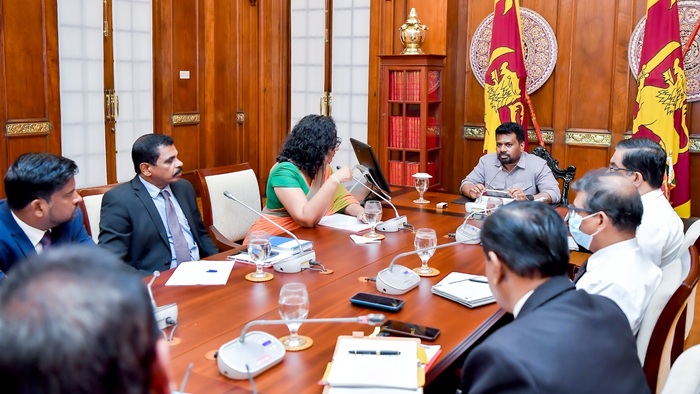
The directive was issued during a discussion at the Presidential Secretariat on June 10, where the National Education Commission presented its concept paper outlining reforms across multiple pillars of the education system.
At the meeting, the Chairman of the National Education Commission stated that the current education reforms are being undertaken across several pillars: early childhood education, general education (primary, secondary and tertiary), higher education, vocational education, technological education, digital education and non-formal education.
Attention was also given to Sri Lanka’s education system to date, the various education reforms implemented over the years, and the social changes brought about by those reforms. The President instructed officials to review previous education reforms and to take into account the key lessons emerging from them when formulating the new education policy framework.
Members of the Education Commission noted that, since the establishment of the National Education Commission in 1991, education policies have been formulated from time to time. They pointed out that a significant portion of the 1997 policy had been applied to primary education.
It was further observed that although a policy was formulated in 2016 for general education, it was not implemented accordingly. Likewise, while an education policy was prepared in 2023, it was not adopted as the national education policy.
Attention was also drawn to the fact that previous education reform efforts had often been based on programmes developed according to the functions of education-related institutions, rather than on a clearly established policy framework guiding educational change.
Describing the present moment as a significant opportunity, the President emphasised that education reforms should be implemented in a manner that does not disrupt the continuity of the existing education process. Rather than creating a separate policy framework and attempting to operate independently through it, reforms should be integrated carefully into the functioning education system.
The President stated that this represents a considerable challenge for the National Education Commission. He also noted that it would be inaccurate to conclude that either the previous education system or the current one is entirely successful or entirely unsuccessful.
He stressed the importance of carefully identifying both the strengths and weaknesses of the existing system. He further observed that it is not possible to determine in the short term whether an education reform is successful or unsuccessful, as its impact must be assessed over the long term through the changes it brings about in society. For this reason, he emphasised that education reforms require greater caution and consideration than many other types of reforms.
Discussions also focused on the need to conduct an in-depth review of anticipated future social challenges and to incorporate into the new policy framework the elements necessary for developing citizens suited to a changing society.
Special attention was given to the need for a policy framework to regulate all sectors of education that are currently not subject to proper regulation, as well as to the adverse consequences arising from the lack of regulation of private education.
The importance of conducting research into university education reform and the regulation of private universities was also discussed.
Among those present were Prime Minister Dr Harini Amarasuriya; Deputy Minister of Education and Higher Education Dr Madhura Seneviratne; Deputy Minister of Vocational Education Nalin Hewage, Chairman of the National Education Commission Professor A. Sarath Ananda; and other members of the Ministry of Education and National Education Commission. (Newswire)