

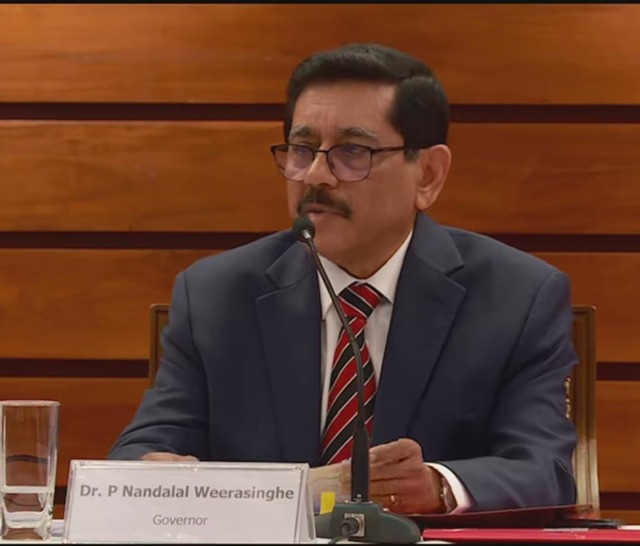
Central Bank Governor Dr. Nandalal Weerasinghe has warned that businesses accepting deposits from the public under the guise of plantation and cultivation investments will inevitably collapse if their operations depend on money from new investors to repay earlier depositors.
Responding to questions over recent action against several companies, Dr. Weerasinghe said entities without legal authority to accept public deposits were violating the law regardless of whether the funds were described as investments linked to cultivation or another business activity.
He said companies promising annual returns of around 40% while also undertaking to return the original investment would be unable to sustain such payments through cultivation alone.
“If you can pay a return of around 40% annually, after all expenses, and also return the original capital at the end, the only way to continue doing that is by taking money from new investors,” the Governor said in substance.
Dr. Weerasinghe said the reduction in new investments following increased public awareness had exposed the underlying problem, with some companies now struggling to repay existing investors.
“When new deposits stop coming in, naturally, as we have seen in previous cases, these businesses will collapse,” he warned.
The Central Bank recently issued freezing orders covering six companies and their directors under the Finance Business Act. The Colombo High Court subsequently confirmed and extended the orders.
The six companies are Kasagala Green Plantation (Pvt.) Ltd, Ceylon Green Life Plantation (Pvt.) Ltd, Singhe Capital Investment Ltd, Pro Shop Advertising Holdings (Pvt.) Ltd, Athens International Education Centre (Pvt.) Ltd and Eyon Lanka Investment & Film Production International Company (Pvt.) Ltd.
According to the Central Bank, investigations are continuing into Kasagala Green Plantation and Ceylon Green Life Plantation, while it has already determined that the other four companies had carried on finance business and/or accepted deposits in contravention of the Finance Business Act.
Dr. Weerasinghe stressed that the Central Bank had not banned plantation or cultivation businesses.
He said businesses remained free to engage in agriculture using their own funds and distribute profits generated from those activities. The legal issue arises when an entity without the required authority accepts deposits from members of the public.
The Governor also rejected claims that the Central Bank’s freezing action itself was responsible for companies being unable to repay investors. He said only funds and assets connected to the alleged illegal deposit-taking had been targeted and that the frozen amount represented only a portion of the money collected from the public.
He said preserving available funds was intended to help minimise losses suffered by depositors and potentially allow funds to be distributed following the relevant legal process.
Dr. Weerasinghe urged people who had already invested money in such schemes to provide the Central Bank with information and evidence, saying such material was important for investigations and legal action.
“If there is any hope of recovering at least part of the money, help us by providing the information,” he said in substance.
The Governor said investigations had also found indications that money collected from the public had been channelled into activities beyond the plantation ventures used to attract investors.
He cited supermarkets, newspapers, tourism-related ventures, entertainment events, sponsorships and payments to artistes among activities for which funds appeared to have been used. He also referred to substantial spending on advertising and social media promotion.
Dr. Weerasinghe urged artistes, media organisations and others to exercise caution when accepting payments or promoting such businesses, warning that the money could ultimately have come from the savings of members of the public.
He also cautioned suppliers and service providers dealing with such companies, saying they too could face losses if businesses used revenue from other operations to sustain the deposit-taking model.
The Governor said the Central Bank would continue to take action equally against entities found to be illegally accepting deposits and urged the public not to put additional money into such schemes.
The Central Bank has separately confirmed that it is investigating several other institutions and individuals following complaints over suspected unauthorised finance business or deposit-taking.
Dr. Weerasinghe urged anyone approached by an entity seeking money with promises of monthly or annual returns to report the matter to the Central Bank, saying complaints and supporting evidence were crucial for authorities to initiate investigations.
Under Sri Lankan law, public deposits may be accepted only by institutions authorised under the Banking Act or Finance Business Act, or entities specifically exempted under those laws. (Newswire)