


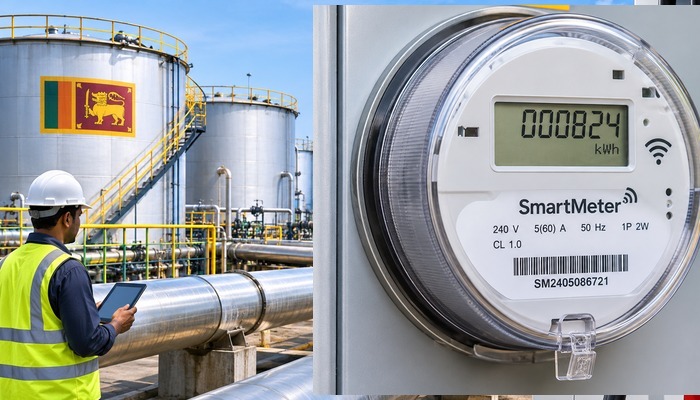
President Anura Kumara Dissanayake has announced a series of measures to strengthen Sri Lanka’s energy security, improve fuel storage and distribution infrastructure, and modernise the electricity supply system under the 2027 Budget.
Presenting the Budget in Parliament, the President said fuel storage capacity would be expanded to ensure supplies sufficient for 45 days.
An allocation of Rs. 22.34 billion has been made for a project to construct a jet fuel pipeline from Muthurajawela to Bandaranaike International Airport (BIA) and develop fuel storage facilities with a capacity of 92,000 metric tonnes.
The Government has also called for tenders for the Rs. 16,332 million Kolonnawa-to-Harbour Pipeline Project, which aims to reduce fuel unloading time from 96 hours to 48 hours.
The project is expected to be completed within 18 months and reduce demurrage costs, with each day of delay currently costing the country approximately US$30,000 in payments to shipping companies.
Meanwhile, the President announced plans to provide free smart electricity meters to 300,000 consumers using more than 180 units of electricity.
All Lanka Electricity Company (LECO) consumers using more than 120 units will also be provided with smart meters.
The Budget also proposes financial incentives to encourage household adoption of battery storage systems alongside rooftop solar installations.
Under the proposed scheme, households installing new rooftop solar systems will receive a subsidy of Rs. 25,000 per kilowatt-hour (kWh) of battery storage capacity, up to a maximum of Rs. 250,000 for systems with a storage capacity of up to 10 kWh.
An allocation of Rs. 3,500 million has been proposed for the programme.
In addition, the Government has proposed removing the 10% Port and Airport Development Levy (PAL) on imported batteries used for solar energy storage.
The measures are aimed at strengthening energy security, improving fuel distribution efficiency and supporting the integration of renewable energy into the national electricity grid.