

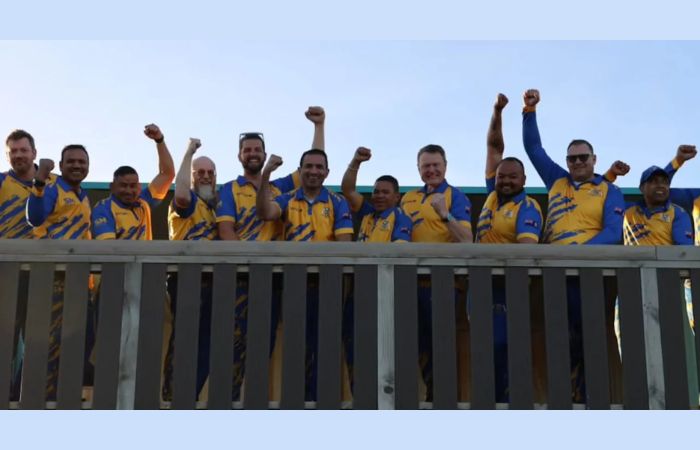
The first chapters of international cricket held by the ICC’s smallest member have been written this week, off the mainland of South America.
The Falkland Islands made the Platinum Ground in the capital of Stanley a fortress in their men’s T20I series against Costa Rica, claiming a 6-2 win.
And it was not just a first for cricket on the Falklands – it’s considered the first international sporting action ever hosted on the islands that is recognised by its international governing body.
There is just one commercial flight a week to the Falklands, running to and from Santiago in Chile, and the territory’s tourist board has a “Getting Here” tab on its website as a need of clarity for the curious traveller. Those on Antarctic expeditions sometimes stop by on the islands, though visitors largely consist of those on military assignment.
To give you an idea of how small the Falklands are in terms of people, you can fit its entire population of around 3,800 people into the Narendra Modi Stadium in Ahmedabad and still have about 128,000 vacant seats. In terms of ICC Members, even Saint Helena, the next-smallest ICC Member by population, has them covered by at least a thousand people.
Platinum Oval in the town of Stanley is further south than New Zealand’s international grounds in Dunedin and Queenstown, and just over a 1000 kilometres from Antarctic land.
With all these factors considered, it means a small window for any cricket at all, let alone an international series and accommodating for overseas guests.
Despite the hurdles, it hasn’t stopped a cricketing nation wanting to make a splash in the game.
“For us to plan anything, we need a year plus or almost, and not just flights,” Falkland Islands captain, coach and secretary Cecil Alexander tells ICC Digital from the ground’s clubhouse after play in their bilateral series with Costa Rica.
“People have to take leave. You need to get the finances in order. And, Costa Rica was willing to work with us, holding this bilateral series.”
“Working around something that’s only once a week (a flight in and out of the country) makes it difficult.
The teams were able to squeeze eight matches into their tight window, even after a shift in scheduling mid-series to accomodate for inclement weather and conditions.
“The weather is not ideal. Sometimes it can be quite windy and not that warm. So it’s very challenging to even consider hosting something like this because a lot of things can go wrong,” Alexander added.
“From late October, sometimes early November and then into March, if we’re lucky, we can go into April with regards to outdoor matches. After that, the temperature goes well below zero sometimes, and obviously (with) snow. It gets just under zero degrees, during the winter with a couple of snowfalls. And then in the summer, if we are lucky, it gets 19, 20 degrees.
“So the past few days, I think the temperature was 11 or 12 degrees, with about 13, 14 mile-an-hour winds, which we here would actually consider a fairly pleasant day under normal circumstances.”
Despite the barren conditions and the island’s position, history of cricket in the Falklands goes back to at least the 1920s and 1930s, with early organised matches played by a local team representing Stanley against players from visiting ships and military. Matches in the 1960s and 1970s were played between Stanley Cricket Club and the local Dependencies Survey (the predecessor of the British Antarctic Survey) and those from naval ships.
After a dip in popularity, the game found impetus in the late 1980s and 1990s, and after forming the Falkland Islands Cricket Association in 2001, sponsorship and fundraising powered cricket on the islands in a successful push to become an ICC Member in 2007. They along other Affiliates became Associate members in 2017 after the governing body’s move to a two-tier system.
Nine years on, the Falklands men ensured their crowning moment would not be scuppered by the visitors, beating them twice on the first day of the series, chasing down 112 and 144 with ease in front of what felt like the entire town in the eyes of Alexander on a long weekend Monday for King Charles III’s birthday.
“There were a lot of people, on the top deck, in the clubhouse and around, and it was just really wonderful to have a good crowd behind us on the sides. Also just cheering for every catch, cheering for every run saved,” he added.
“It was really good that the community was quite involved and very supportive.
“There’s a lot of other activities that also happened over the weekend, so there was a lot going on, but we had a really good turnout for the cricket as well.
“And I definitely think we’ve made some believers out of that, that Cricket is an interesting sport to watch.”
The series may well have given the youngsters on the boundaries some heroes to look up to as well if performances during the series are to go by. (ICC)