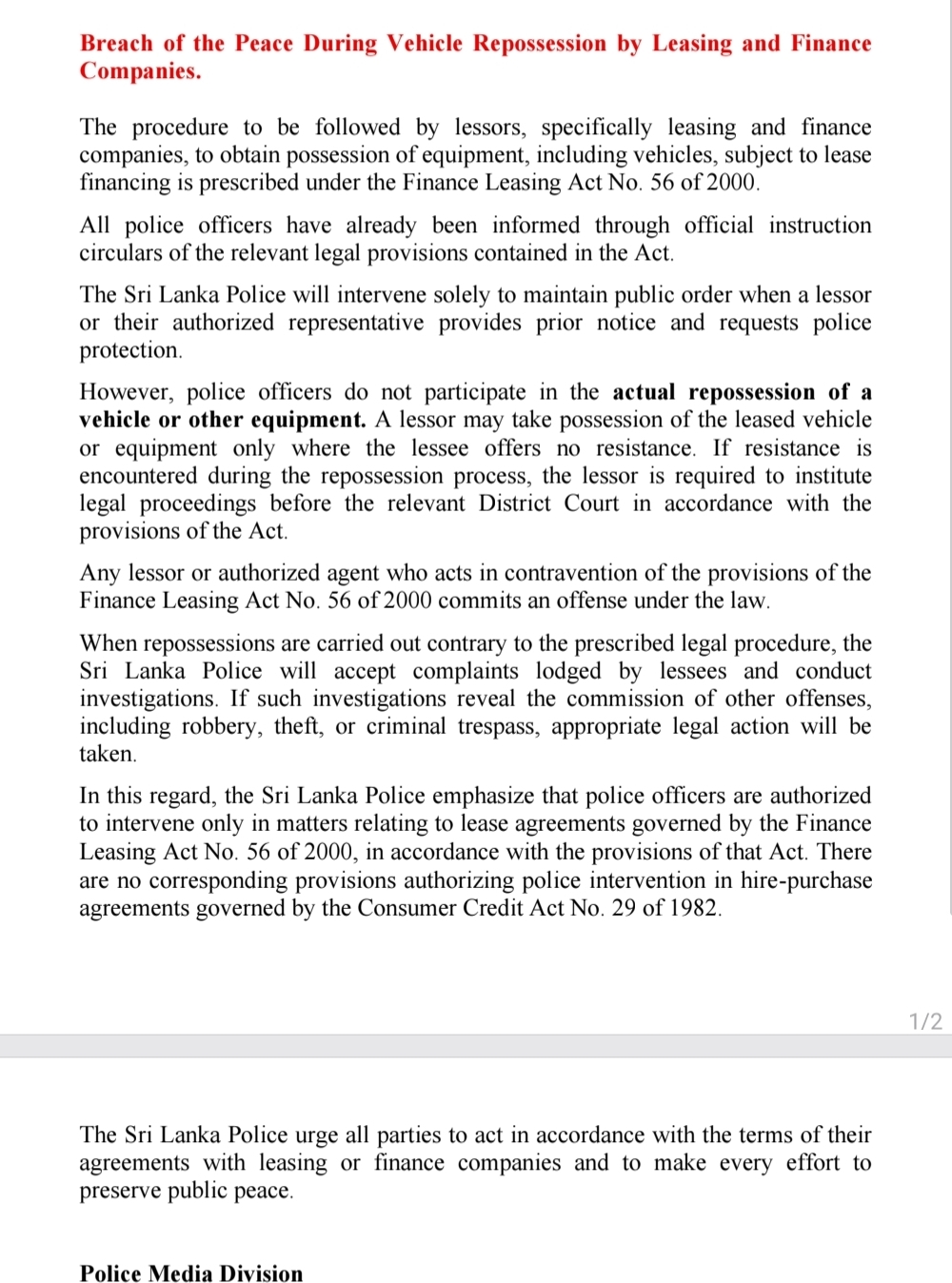


The Sri Lanka Police have clarified the procedures governing the repossession of vehicles and other equipment by leasing and finance companies, stressing that police officers do not participate in the actual repossession process.
Under the Finance Leasing Act No. 56 of 2000, lessors and their authorized representatives must follow prescribed procedures when seeking possession of leased property, including vehicles. Police officers have been informed of the relevant provisions through official instruction circulars, according to the Police Media Division.
Police may intervene solely to maintain public order when a lessor or authorized representative provides prior notice and requests police protection. Officers, however, are not authorized to participate in taking possession of a vehicle or other leased equipment.
A lessor may repossess leased property only when the lessee offers no resistance. If resistance occurs, the lessor must seek legal remedies through the relevant District Court in accordance with the Finance Leasing Act.
The police said any lessor or authorized agent who violates the provisions of the Act commits an offense.
Where a repossession is carried out contrary to the prescribed legal procedure, lessees may lodge complaints with the police. Investigations will be conducted, and if offenses such as robbery, theft or criminal trespass are established, appropriate legal action will be taken.
The police also clarified that their authority to intervene in lease-related matters applies to agreements governed by the Finance Leasing Act. The Consumer Credit Act No. 29 of 1982 contains no corresponding provisions authorizing police intervention in hire-purchase agreements, the Police Media Division said.
The police urged all parties to comply with the terms of their agreements with leasing and finance companies and to take steps to preserve public peace. (Newswire)