

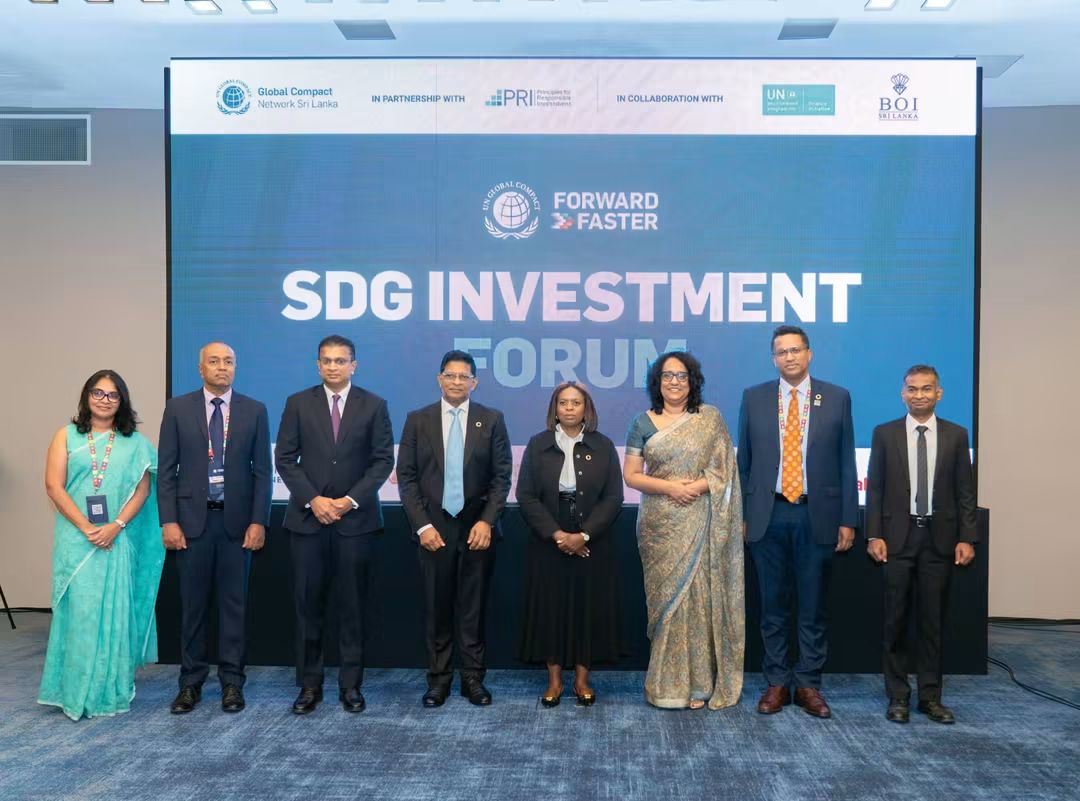
Sri Lanka remains open to transparent, long-term investment, while the government will support businesses that uphold human rights, protect the environment and contribute to equitable economic growth, Prime Minister Harini Amarasuriya said.
Speaking at the Asia-Pacific SDG Investment Forum in Colombo on Wednesday (12), organised by the United Nations Global Compact and the Board of Investment of Sri Lanka, Amarasuriya said investment was essential to closing the financing gap faced by developing countries and advancing the Sustainable Development Goals (SDGs).
She said developing countries currently face an annual financing gap of between $2.5 trillion and $4 trillion, with the Asia-Pacific region accounting for about $1.5 trillion of that gap.
Amarasuriya said the country had begun rebuilding and stabilising its economy after a difficult period, with economic growth reaching 5% in 2025 and gross domestic product rising to $108.8 billion.
However, she said the government’s objective was not simply to increase economic indicators, but to achieve economic transformation that creates employment and ensures that the benefits of growth are shared fairly.
The prime minister said the government would provide maximum support to the business sector, while stressing that it expected investments to go beyond profit-making.
She identified decent wages, vocational training, proper tax payments, environmental protection and greater participation by women and historically marginalised groups as key responsibilities and priorities.
Amarasuriya also highlighted climate-related risks to agriculture and energy security, saying the Sustainable Finance Roadmap and Green Finance Taxonomy introduced by the Central Bank of Sri Lanka were intended to help address such challenges and improve access to finance for small and medium-sized enterprises.
United Nations Assistant Secretary-General and United Nations Global Compact CEO and Executive Director Sanda Ojiambo said the world faced interconnected climate, energy and financing crises.
She said the challenge was not a lack of capital, noting that while the financing gap for achieving the SDGs stood at about $4 trillion, the private sector held an estimated $22 trillion. The priority, she said, was to direct investment towards areas that could generate returns while improving people’s quality of life.
Ojiambo said greater investment was needed in areas including housing, fair wages, equality, education and clean energy, while stressing the importance of redirecting investment away from fossil fuels.
She also called for greater trust, transparency and cooperation between governments, businesses, banks, investors and policymakers to address the financing gap in the Asia-Pacific region.
The forum was attended by Central Bank Governor Nandalal Weerasinghe, representatives of the United Nations Global Compact, private-sector executives from the Asia-Pacific region, diplomats, sustainable development experts and sectoral leaders. (Newswire)