

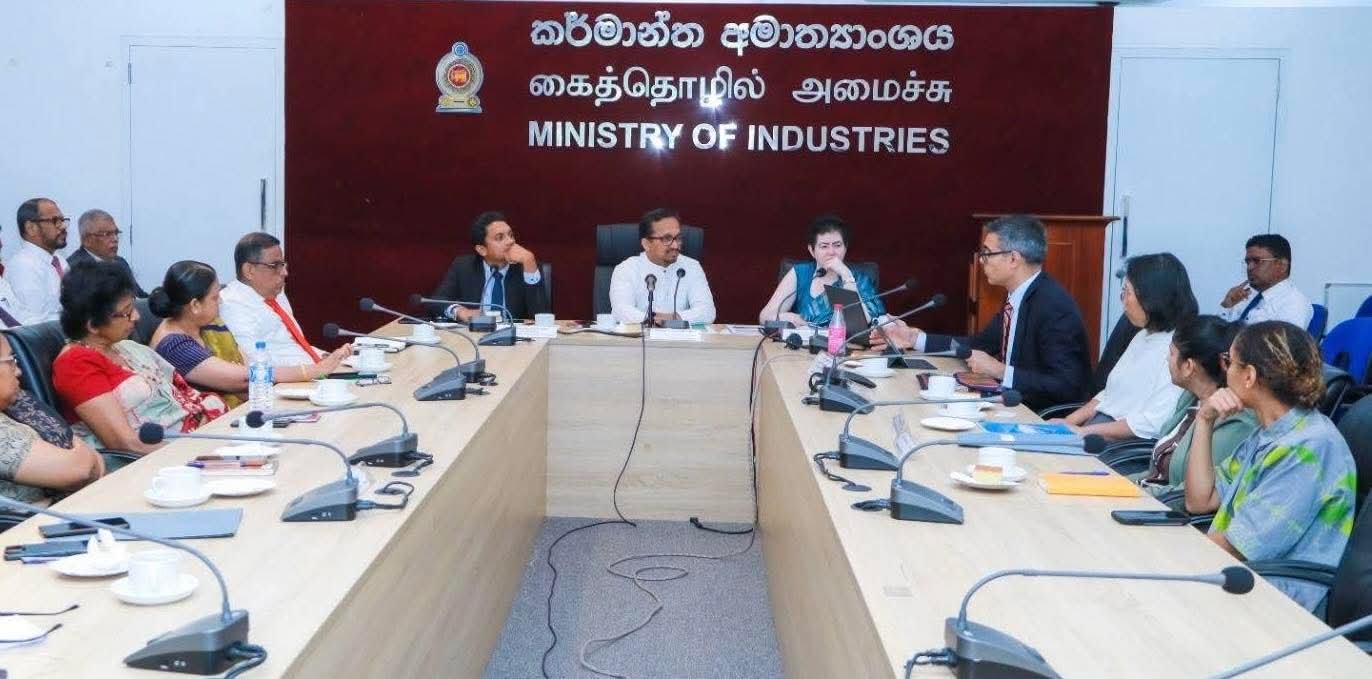
- Driving Industrial Recovery and Transformation: Q1 2026 Progress Report
Ministry of Industries & Entrepreneurship Development
Sri Lanka’s industrial sector entered 2026 with renewed momentum, underpinned by a clear reform agenda, targeted infrastructure investments, and strong institutional coordination. The first quarter has been marked by decisive progress across policy, financing, industrial recovery, and international partnerships laying the groundwork for sustained, private sector-led growth.
✅Accelerating Infrastructure for Industrial Growth
Infrastructure development continued to play a catalytic role in enabling regional industrial expansion. The Beruwala boat launching pad recorded steady progress, strengthening marine and fisheries-linked industries.
At the same time, industrial zones in Dambulla, Aruthapola, and Milanniya (Alpitiya) are nearing completion, signaling a major step toward decentralised industrialisation and regional job creation.
Investing in human capital remained a priority, with the new student facility at the Sri Lanka Institute of Textile & Apparel (SLITA) officially opened enhancing industry-ready skills in one of Sri Lanka’s key export sectors.
✅ A New Policy Architecture for Industrial Transformation
Q1 saw the completion and rollout of a comprehensive policy and regulatory framework designed to modernise Sri Lanka’s industrial ecosystem.
Key milestones include the launch of the Export Development Strategy, alongside the finalisation of the New Industrial Development Act, which will provide the legal backbone for future industrial growth.
Reforms also advanced in trade and manufacturing regulation, with the Standard Operating Procedure (SOP) for vehicle assembly completed and a new National Tariff Policy initiated to improve competitiveness and rationalise protection.
To ensure fair market conditions, the Anti-Dumping Policy entered implementation, while the National Mineral Policy received Cabinet approval unlocking value from Sri Lanka’s natural resources.
Institutional reforms also progressed significantly. The National Business Registry Framework, developed with World Bank support, was completed, while the 11-Pillar SME Framework and National SME Policy were finalised, setting the stage for a more structured SME development ecosystem.
In parallel, the National Incubator Framework was finalised, with its launch expected in Q2—marking a critical step toward nurturing innovation and startups.
✅ Expanding Access to Finance for SMEs
Improving access to finance remained central to the Ministry’s efforts in supporting entrepreneurship and small businesses.
In collaboration with the Ministry of Finance, the SME soft loan process was simplified, enabling faster and more inclusive access to capital. This contributed to strong financing outcomes in Q1, with over Rs 31Bn loans approved and more than 5,000 businesses supported.
The National Credit Guarantee Scheme is actively operational, significantly reducing risk barriers for lenders and unlocking credit flows to underserved segments where over 350 loan approved this year.
Targeted support was also extended to crisis-affected enterprises, with LKR 200,000 grants provided to 5,600 businesses impacted by DITWA disruptions ensuring continuity and recovery at the grassroots level.
✅ Strengthening Global Partnerships
International collaboration continued to play a strategic role in shaping Sri Lanka’s industrial financing landscape.
A joint study with the United Nations Development Programme (UNDP) on last-mile financing and microfinance solutions was completed, offering actionable insights into improving financial inclusion.
Simultaneously, ongoing collaboration with the World Bank Group is advancing the establishment of a Fund of Funds, aimed at strengthening the startup ecosystem and catalysing venture capital investment in Sri Lanka.
Held successful negotiations with IMF to seek support for growth phase
✅ SOE Reform and Resource Optimisation
The Ministry made steady progress in restructuring state-owned enterprises to improve efficiency and unlock value.
Expressions of Interest (EOI) were completed for the National Phosphate Company, while similar processes were initiated for Kahatagaha Graphite and Kurinchathivu Salt, signaling a move toward greater private sector participation and improved governance.
✅ Reviving Industry and Supporting Innovation
A range of targeted interventions were implemented to support industrial recovery and competitiveness.
Grant schemes were launched to assist exporters in achieving standards and Good Manufacturing Practice (GMP) compliance, enhancing access to international markets.
The DITWA industry recovery programme was successfully completed, while the Industrial Development Board (IDB) conducted impact assessments across 243 large and medium-scale industries, ensuring evidence-based policy support.
Operational challenges were also addressed through effective coordination with the Ceylon Petroleum Corporation (CPC) to maintain uninterrupted fuel supply for industries.
Innovation and import substitution efforts gained traction with the successful completion of a pilot project for locally manufactured school shoes.
In collaboration with the University of Moratuwa and the National Craft Council, four product development programmes are currently underway—covering textiles and batik, reed-based products, bobbin lace, and the C2M creative economy project.
✅ Strengthening Legal and Institutional Foundations
Work continued on reinforcing the Ministry’s long-term strategic and legal framework.
The 2026–2030 Strategic Plan is currently being updated, while the Industry Promotion Act is in its final stages. The formulation of a new National SME Policy Framework has also commenced.
A major institutional reform milestone was achieved with the development of the Industrial Transformation and Innovation Authority, which will serve as a central driver of industrial modernisation.
In parallel, National Organic Standards and Regulations were upgraded to align with UK standards and have gained international recognition under the IFORM family of standards enhancing Sri Lanka’s positioning in global organic markets.
✅ Driving Productivity and Competitiveness
Productivity enhancement initiatives gained momentum during the quarter. The evaluation process for the Productivity Awards 2025 is currently underway, recognising excellence across industries.
The Productivity Village Programme, implemented under the Clean Sri Lanka Programme, is also progressing promoting efficiency and sustainable practices at the grassroots level.
✅ Promoting Industry and Expanding Markets
Industry engagement and market development remained active throughout Q1.
The successful conclusion of the Boat & Marine Show and the Footwear and Leather Fair provided valuable platforms for industry visibility and networking.
While the Sri Lanka Expo 2026 has been rescheduled to Q1 2027, preparations are underway for a high-level Investment Forum in June 2026, organised in collaboration with the World Bank, Export Development Board (EDB), Board of Investment (BOI), and Port City.
In a significant digital step forward, the Ministry launched the Sri Lanka Expo 2026 Virtual Platform, creating an integrated hub for investment promotion and international trade engagement.
👉 Conclusion
The first quarter of 2026 reflects a clear shift from stabilisation to structured growth. With strong progress in policy reform, financing access, industrial recovery, and global partnerships, Sri Lanka is building a resilient and competitive industrial base.
The focus in the coming quarters will be on implementation, scaling impact, and ensuring that these reforms translate into tangible outcomes jobs, exports, innovation, and inclusive economic growth.