

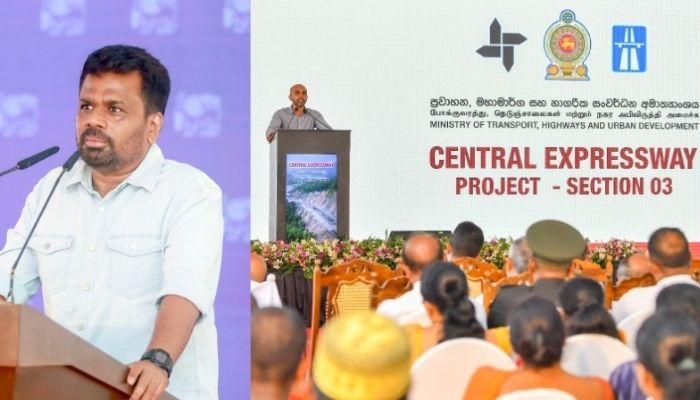
President Anura Kumara Dissanayake stated that the present Government did not come to power merely to somehow drag the country through a five-year term, but to build a resilient economy capable of withstanding any internal or external shock that may arise. The President further noted that the Government is currently working with a clear vision and a well-defined plan regarding the direction in which the country’s economy should move.
The President pointed out that previous governments had sustained themselves during their terms by obtaining high-interest commercial loans from the market, whereas the current Government has already achieved success across several key economic indicators. He stated that, through this course of action, the country is now steadily moving towards a strong and stable economy.
President Anura Kumara Dissanayake made these remarks while addressing a public gathering held this afternoon (29) at the Galagedara Public Grounds to mark the commencement of development work on the 18.7-kilometre stretch from Rambukkana to Galagedara under Phase II of Section III of the Central Expressway Project.
The President further pointed out that, for the first time in Sri Lanka, a Government that genuinely thinks about the future has come to power. President Dissanayake stated that the Government remains committed to delivering the development the country requires while maintaining debt sustainability and effective debt management at an optimal level.
Implemented under the supervision of the Ministry of Transport, Highways and Urban Development and the Road Development Authority, the second phase of the project will be carried out with the support of domestic funding and local contracting companies at an estimated cost of Rs. 112.44 billion. Construction of the four-lane section is scheduled to be completed by 28 May 2029.
Meanwhile, the first phase of the project, from Pothuhera to Rambukkana, which is currently under construction, is expected to be completed by the middle of next year.
Speaking further, President Anura Kumara Dissanayake stated:
“Today marks the beginning of a major infrastructure development project targeting the Kandy District and its surrounding areas. This project will serve as a strong driving force in improving the social life of our people.
Our Minister, Deputy Ministers, Secretary and the relevant officials have made a tremendous effort to commence this project. At the same time, we have placed our confidence in local contractors, believing that they will complete the work within the stipulated timeframe while maintaining high standards and advanced technical quality.
There has recently been considerable discussion in the country regarding fluctuations in the value of the US dollar. Some claim that the Government will collapse and offer unsolicited advice. However, we are working with a clear vision and a well-defined plan regarding the possible challenges facing our economy and the direction in which it must move. That is why we need a strong economy capable of restoring stability quickly in the face of any storm or instability that may arise at any moment. It is true that we have not yet fully mobilised all the strengths of our economy. We have not yet attracted the level of investment we require. We have not yet created a new generation equipped with the knowledge to work with modern technologies. Nor have we yet developed the economic strength necessary to successfully compete in global markets. Nevertheless, our challenge and our aspiration are clear to build an economy that remains resilient and unshaken in the face of any crisis or challenge.
Domestic economic shocks can now be managed to a considerable extent. In response to the recent Ditwah cyclone, we were able to allocate Rs. 500 billion from the Treasury for relief and recovery efforts. This represents the first occasion in Sri Lanka’s history where the largest financial allocation has been made in response to a disaster.
In this manner, we have strengthened our capacity to respond effectively to internal shocks. However, it is essential that the economy is also developed to withstand external shocks, in addition to domestic ones. There is a saying that when powerful nations catch a cold, smaller nations suffer pneumonia. In other words, an economic crisis in major economies can have a severe impact on us. External shocks can occur at any time and the question is how we prepare the economy to withstand such situations.
Today, we have achieved significant progress in several key economic indicators. We have increased the national revenue ratio to 16.7%, the highest in three decades. This is a notable achievement, which has also contributed to a surplus position in the Treasury. During 2022 and 2023, the Treasury operated with an overdraft of approximately Rs. 800 billion, with virtually no available fiscal space.
Therefore, banks, the private sector and businesses were unable to obtain sufficient credit and the financial market began to contract. However, we have now been able to transform the Treasury account into a surplus position of Rs. 120 billion. Today, instead of being a major borrower, the Government is facilitating credit flow to the private sector.
In 2024, the banking system allocated Rs. 700 billion for industrial lending. In 2025, lending to the private sector has increased to Rs. 2,000 billion, reflecting a rapid acceleration in economic activity. In April alone, Rs. 250 billion was disbursed to the private sector. This represents a significant turning point in the economy. Furthermore, it is planned to allocate Rs. 2 trillion in capital expenditure for the year 2027. The Central Expressway project alone will require Rs. 112 billion over three years, which amounts to approximately Rs. 35 billion per year. That is why we have stated that work on the Kurunegala–Dambulla road can also be commenced, as sufficient funding can be allocated. Similarly, funds can be provided for railway electrification.
However, we face challenges related to the underutilisation of allocated funds within the required timeframe. Delays, therefore, invariably translate into additional costs. Accordingly, contractors are urged to ensure that projects are completed within the stipulated timeframes.
We are developing highways and the necessary supporting infrastructure, as well as infrastructure for energy, railways and the digital economy. We are now entering a development pathway guided by a structured plan and clear vision.
Sri Lanka has, for the first time, a government that is thinking about the future. Today, we borrow with careful consideration of whether repayment will be sustainable in 2035 and 2040. Our borrowing is expected to be maintained within a limit of 4% of Gross Domestic Product, beyond which the economy would not be able to withstand further pressure. We remain firmly committed to this position. Accordingly, borrowing decisions are made on the basis of long-term debt sustainability, assessing whether repayment obligations remain within manageable limits in 2035 and 2040. This is the true essence of debt management. A country cannot be built by borrowing indiscriminately from multiple sources. We are working with a structured plan to maintain debt at an optimal and sustainable level. We are confident that this trajectory is leading our country towards a far stronger and more resilient economy.
Senior members of the Maha Sangha and other religious leaders, along with Minister of Transport, Highways and Urban Development, Bimal Rathnayake, Deputy Ministers of Transport and Highways, Prasanna Gunasena and Urban Development, Eranga Gunasekara, Deputy Minister of , Hansaka Wijemuni and Members of Parliament Riaz Farook and Thanura Dissanayake, were also present.
Senior officials including the Secretary to the Ministry of Transport, Highways and Urban Development, Professor Kapila Perera, Kandy District Secretary Indika Udawatta, Chairman of the Road Development Authority T. Paskaran, together with government officials, local residents and others, attended the event. (PMD)