

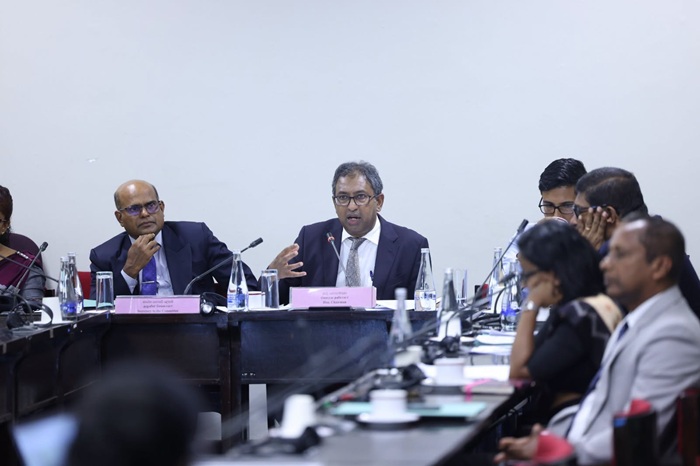
The Committee on Public Finance (CoPF) has approved a Rs. 71.7 billion relief package under Supplementary Estimate No. 03 of 2026 to support communities impacted by the economic fallout of the Middle East conflict.
Meeting in Parliament on 28 July under the chairmanship of MP Harsha de Silva, the Committee reviewed allocations across fuel, electricity, agriculture, fisheries, and social welfare, while stressing that the package represents a reallocation of existing budgetary provisions rather than an increase in expenditure or borrowing limits.
During the discussion, it was revealed that the largest allocation under the Rs. 71.7 billion relief package, amounting to Rs. 52.8 billion, has been earmarked for the petroleum sector. Officials informed the Committee that the allocation was made to offset potential losses arising from increased fuel landing costs and to ensure the uninterrupted supply of fuel, thereby preventing possible shortages in the country.
Officials further explained that the Rs. 71.7 billion allocation consists of two components. The first is Rs. 52.8 billion reallocated to settle payments relating to relief measures, including fuel subsidies provided during May and June 2026. The second is Rs. 18.9 billion reallocated to replenish the annual budget contingency reserve, which had been utilized to finance the April 2026 fuel subsidy for the Ceylon Petroleum Corporation and other fuel suppliers, fertilizer subsidies for smallholder tea growers, and assistance provided to the fisheries sector.
The Committee was informed that, similar to the Rs. 20 billion Supplementary Estimate reviewed on 11 June 2026, this request would not increase either the expenditure ceiling or the borrowing limit for 2026. It was clarified that the proposal represents only a reallocation of already approved budgetary provisions.
It was also disclosed that the entire Rs. 71.7 billion allocation will be financed from the unutilized balance of the Rs. 500 billion Supplementary Estimate No. 01 of 2026, which had been allocated for relief and recovery measures following Cyclone Ditwah. As at 30 June 2026, only Rs. 243.9 billion of that allocation had been utilized.
Accordingly, the Committee noted that the fuel subsidy should be viewed as a consumer relief measure rather than a subsidy granted to fuel companies, and that it is a temporary intervention introduced in response to the prevailing circumstances.
The Committee was further informed that fuel suppliers, including the Ceylon Petroleum Corporation, received subsidies amounting to approximately Rs. 20,507 million for April 2026 alone. Of this amount, Rs. 15,000 million was allocated to the Ceylon Petroleum Corporation, Rs. 2,340 million to Lanka IOC PLC, Rs. 1,501 million to Sinopec, and Rs. 1,666 million to RM Parks.
The Committee also discussed the overall distribution of the Rs. 71.7 billion relief package, under which Rs. 15 billion has been allocated to the Ceylon Electricity Board, Rs. 8.2 billion for the Aswesuma programme, Rs. 3 billion to support agricultural activities during the Yala cultivation season, Rs. 2.2 billion for smallholder plantation farmers, and Rs. 1.2 billion for the fisheries sector.
The Road Development Authority also briefed the Committee on the progress of projects undertaken following the damage caused by Cyclone Ditwah. Officials stated that the Governments of India and China have pledged assistance for the reconstruction of damaged bridges. They further informed the Committee that construction of the Galagedara and Rambukkana interchanges of the Central Expressway is expected to be completed by the end of 2028. It was also noted that tenders have already been called for the electricity supply system for the expressways and that work is expected to commence within the next three months.
The Committee also discussed the potential impact of the El Niño phenomenon. Chair of the Committee, MP Harsha de Silva, emphasized the importance of strengthening the Disaster Management Statutory Fund to enable the country to respond more effectively to future climate-related events.
In addition, the Committee held an extensive discussion on the determination of the salary of the Auditor General. Views were also exchanged on matters relating to the public sector salary structure. The Committee decided to continue deliberations on these matters at a future meeting before reaching a final decision. (Newswire)