

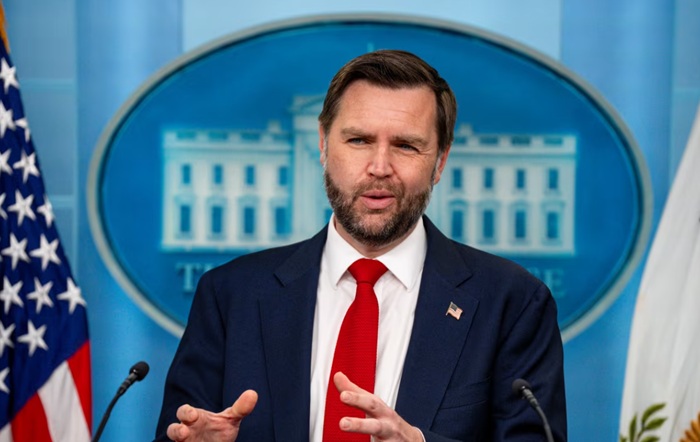
United States Vice President JD Vance pulled out of a planned trip to meet Iranian negotiators in Switzerland on Friday (Jun 19) to begin complex talks on implementing the 14-point agreement struck between Tehran and Washington to end their war, a White House spokesperson said.
The cancellation of the talks was later confirmed by the Swiss foreign ministry, which said in a statement that the meeting at the Burgenstock mountaintop resort will not take place.
US officials said this week they would hold a formal signing ceremony for the US-Iran agreement in Geneva, but Iran’s foreign ministry cast doubt on that, saying it was unnecessary after both countries’ presidents signed the agreement on Wednesday.
Iran had said it was ready to begin technical talks after the two enemies extended a tenuous ceasefire by at least 60 days with the accord.
But the semi-official Tasnim news agency said earlier on Thursday, before Vance’s announcement, that Iran’s negotiators needed to see signs of implementation of the interim agreement from the US before the next rounds of peace talks could begin, and that there was no confirmation that its delegation would travel to Geneva.
Vance and the US delegation had been ready to depart as soon as plans for the talks had been finalised, the White House spokesperson said in a statement on Thursday night. “But the logistics of these negotiations have never been simple or predictable,” the statement said.
There was no immediate response from Iran’s government.
The diplomatic back-and-forth over the planned ceremony and photo-op adds to the uncertainty over whether a lasting truce can be found to a regional war that has killed at least 7,000 people, sent energy prices soaring and shaken global markets.
HORMUZ NAVAL BLOCKADE LIFTED
American forces on Thursday lifted their naval blockade of Iranian ports that had prevented ships from sailing to or from the Islamic Republic, the US military said, noting that American warships “will remain in the general area”.
Activity was still muted in the Strait of Hormuz, the strategic bottleneck for energy shipments that Iran blockaded during the conflict.
Three Saudi oil tankers left the Gulf through the strait on Thursday, maritime trackers said, as did a French vessel loaded with liquefied natural gas.
Iranian state TV, citing a statement from the country’s Supreme National Security Council, said that ships “seeking passage through the Strait of Hormuz must submit their request” to a new government body tasked with overseeing the waterway.
In keeping with the terms of the deal, it added, “no fees whatsoever will be collected from applicants for a period of sixty days”.
ISRAEL CONTINUES FIGHT
Israel, which was not included in the peace talks and has distanced itself from the US-Iran accord, continued its fighting against the Iranian-allied Hezbollah militant group in Lebanon, also raising questions about whether the agreement would hold.
In Washington, some of US President Donald Trump’s Republican allies in Congress questioned whether he had given up too much in order to end the conflict, which is unpopular with most Americans.
Trump previously wrote he would only end the war with Iran’s “UNCONDITIONAL SURRENDER”, but the memorandum he signed with Iran instead provides relief from economic sanctions, unfreezes assets worth tens of billions of dollars and immediately provides US waivers for Iran to export its oil.
Iran’s Supreme Leader Ayatollah Mojtaba Khamenei said Trump had signed the deal “out of desperation” and signalled that upcoming talks over Iran’s nuclear programme, among Trump’s stated reasons for starting the war, would not be easy.
“If the American side wants to be too demanding, we will not accept it,” he said in a written message.
The deal gives negotiators 60 days to reach an agreement on the status of Iran’s nuclear programme unless both sides agree to an extension, and set up a US$300 billion reconstruction fund for Iran and other financial incentives.
Vance said Washington would also seek to limit Iran’s long-range missiles. (CNA)