

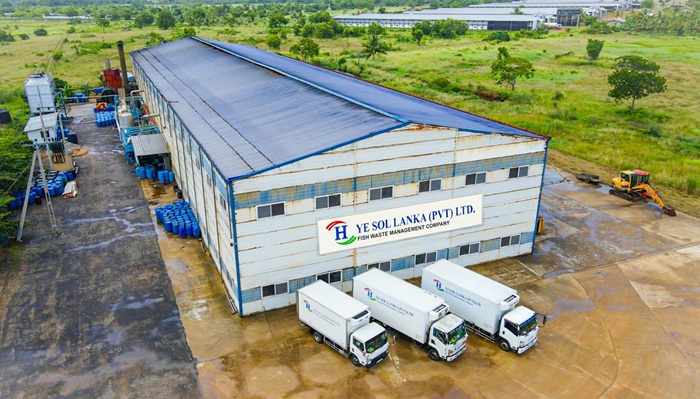
Yesol Lanka, a Board of Investment (BOI)‑approved enterprise based in Madurankuliya, Puttalam, has transformed Sri Lanka’s discarded fish waste into a profitable export industry.
According to a BOI statement, for decades, fish heads, frames, viscera, and skins piled up at markets as an environmental burden. Today, through Yesol Lanka’s fish‑waste valorization project, that same stream is being converted into internationally traded animal feed ingredients, generating foreign exchange, employment, and a cleaner coastline.
Founded by entrepreneur Vijitha Kumara Rajapaksa, who gained expertise in fish‑waste valorization while working with South Korea’s Hantech Group, the project has introduced new technology to convert waste into animal feed ingredients. The BOI approved the venture citing four benefits: tackling a worsening environmental problem, generating foreign exchange, creating jobs, and providing fishermen and collectors with new income.
Established on a 50‑acre site with an investment of US$ 3 million, Yesol Lanka employs 45 people directly and processes up to 100 metric tons of fish waste per day. Fishermen and collectors are paid Rs. 20–30 per kilogram for waste that previously had no market. The company now exports 30,000–35,000 metric tons annually of fish meal, fish oil, and fish paste, earning US$ 2–2.5 million a year. Its clients include Vietnam’s CP Company, a global leader in shrimp farming.
Yesol Lanka has also achieved 100% Green Project status by adopting recyclable packaging. The BOI highlights the venture as a model for converting environmental liabilities into export‑earning industries, noting that Sri Lanka currently processes less than 3% of its total fish catch into marine ingredients despite landing 480,000–530,000 metric tons annually.
Globally, the fishmeal and fish oil market is valued at US$ 9.9 billion in 2026 and projected to reach US$ 19.1 billion by 2036, while the aquafeed market is forecast to grow from US$ 67.7 billion in 2026 to US$ 97.1 billion by 2031. With Asia‑Pacific already accounting for more than 42% of consumption, Sri Lanka is well‑positioned to expand exports into nearby aquaculture and pet‑food markets.
Speaking on the venture’s progress, Vijitha Kumara Rajapaksa urged Sri Lanka’s youth to embrace innovative, export‑oriented entrepreneurship, while the BOI continues to encourage similar circular‑economy investments that generate foreign exchange and promote sustainability. (Newswire)